Welcome to K C Yan's Singapore Math blog!

Wanting to be updated on Singapore Math news or new Singapore Math? You have come at the right place! Please leave your comments before leaving. A googol thanks.

Singapore Math

Showing posts with label poetry. Show all posts

Sunday, June 29, 2025

Does AI Sulk at Counting?

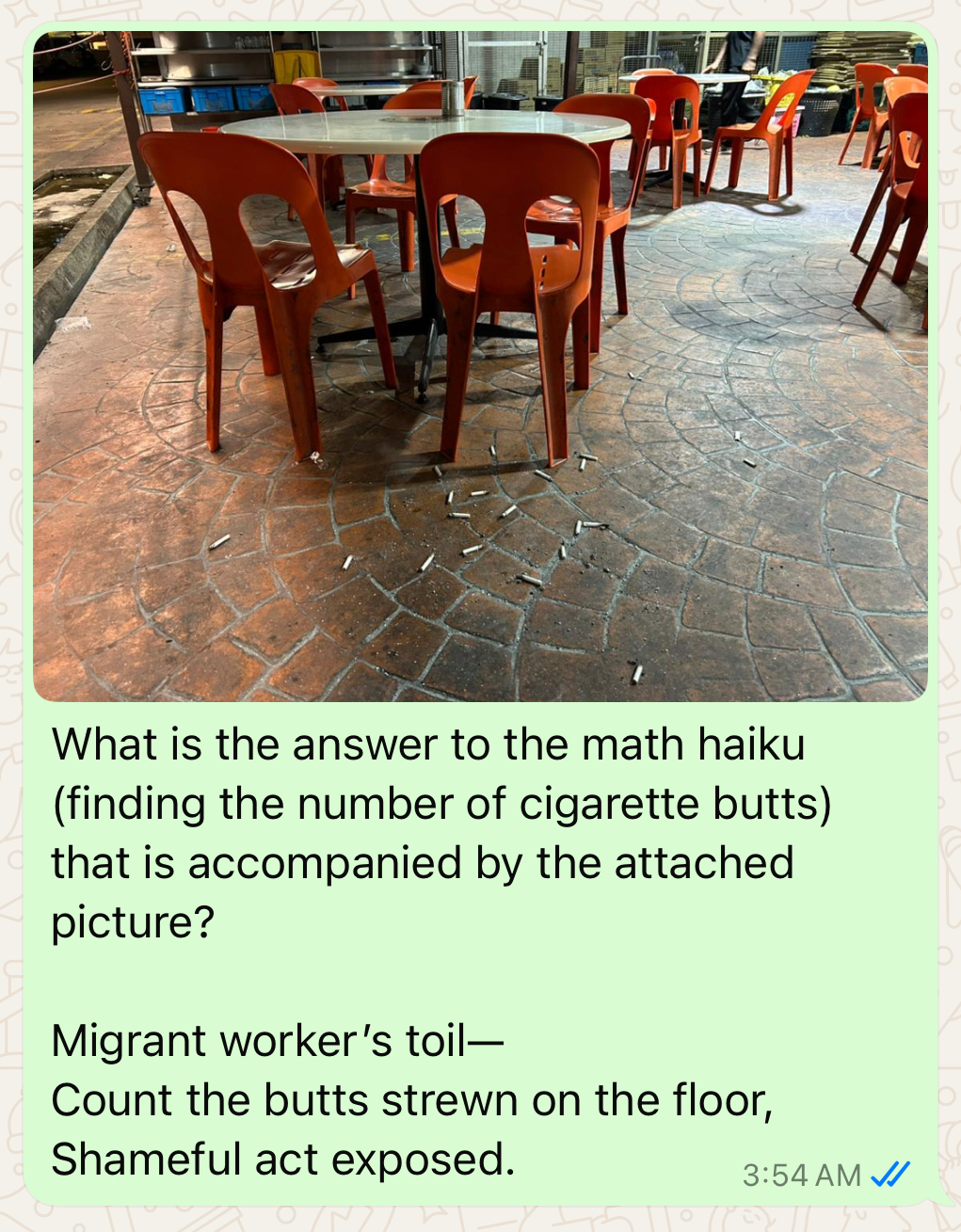
Six days ago, in the wee hours at a 24/7 neighborhood coffeeshop, I spotted the unsightly aftermath of a chain-smoker’s bad habit. Below is a shot of its dirty floor:


While sipping my tea, it crossed my mind to convert that Ugly Singaporean’s behavior into a math question in the form of a haiku.

I crafted the maiku tongue-in-cheek and X-ed the following:


The Ugly Singaporean

Migrant worker’s toil—

Count the butts strewn on the floor,

Shameful act exposed.


A few days later, for no reason, I was prompted to ask AI for the number of cigarette butts on the floor.

Below are the exchanges or arguments I had with my virtual math teacher.


At 26, I decided to end the conversation, albeit I believed that with some persuasion I’d have tricked AI to agree with me that the answer could be 10π.

Now, it’s your turn to tell us the exact number of butts, by outsmarting AI. What’s the correct answer?

Humanly yours

© Yan Kow Cheong, June 29, 2025.

Monday, October 14, 2024

Murderous Pi


Political Pi
 

When π thought that she’d never want to be associated with gun violence and senseless death, was she just being politically positive or naive?

Pi’s fear has now come true. Without repeated funding from gun manufacturers and pollution-enabled organizations, an obscene number of morally corrupt halfwitted lawmakers in TrumpLand would never get elected or reelected.

Even as you’re reading this, the odds of another senseless shooting or tragedy currently being witnessed in some red-pilled states are anything but zero.

It looks like if only those GOP selfish lawmakers and their loved ones or friends were the victims, maybe then they’d eventually do something about gun control; otherwise, it’s all NATO (No Action Talk Only).


Should Math Teachers Be Armed?

The Blame Game

People are sick of hearing the years-long canned story from inept and morally bankrupt politicians, who simplistically blame mental health, inequality, racism, or whatever social ills, rather than the free flow of guns for the recurring senseless deaths. It’s like the political equivalent of scapegoating the forced learning of algebra for the nation’s high innumeracy rate.

The U.S. is the only “civilized” nation in the developed world that has continually shortchanged its schoolchildren and their teachers. When profits and politicians triumph over principles and people.

Or, only in TrumpLand do we read about these senseless school gun deaths—when students shoot teachers and their peers because they can do it. And those preventable school shootings have only got more frequent and resulted in higher casualties in recent years.


Murderous Statistics

Below are some “murderous statistics” I’d tweeted over the years following numerous school shootings:

Sadistic Statistics from the National Rifle Association (NRA): “No guns, very high murder rates; more guns, very low murder rates.”

Murderous Math: People in the U.S. are 20 times more likely to be killed by a gun than someone else in another developed country.

Gun Ownership: Singapore ranks among the bottom 10 for the number of privately owned guns per 100 people.

It’s said that the chance of a 15-year-old boy dying by the age of 50 is now higher in America than it is in Bangladesh. The odds might even be higher now with Trumpism and moral bankruptcy plaguing Trumpublicans.

Deadly Statistics: The positive correlation between the coronavirus and the growing gun sales in the U.S., which has the highest crime rate in the developed world.


Dark Problem Solving

Ironically, school and gun shootings in the U.S. have provided math educators with real-life math problems, which could be used to hone students’ guesstimation skills. Two such questions are:

Political Math: Guesstimate how many “corrupt zeros” Trump and his billionaires-donors (and the mostly morally corrupt GOP lawmakers) pocketed, by protecting profiteering guns, insurance, and pharmaceutical companies.

Death Statistics: How many students in the U.S. senselessly die every year from gun violence?


No Gun Reduction, but God’s Protection


Let’s end with a haiku I recently X-ed in the aftermath of Trump’s lackey saying that school shootings are a “fact of life.”

Serial School Shootings

Money politics
that support gun businesses.
That’s a “fact of life.”


If the U.S. is dead serious about protecting schoolchildren and teachers from gun shootings, maybe it’d do it the Singapore way: Zero tolerance for gun sale to 99.99% locals. Vote out politicians who’re funded by weapon manufacturers.

Safely & securely yours

© Yan Kow Cheong, October 14, 2024.

Monday, April 22, 2024

Thou Shalt Keep the Mathematical Sabbath!


The Weak Days of the Week


It’s said that working seven days a week makes one weak. Even workaholics who often wished they had an eight-day week couldn’t go on their routine hoping to ever be productive or creative sans experiencing a breakdown sooner than later.


Four-Day Work Week

Recently, there was much talk in the “fine” city about a four-day working week. Sounds like good news for tens of thousands of employees, especially those in the civil service, but bad news for profits-over-people employers or bosses in the private sector, who don’t subscribe to a workplace promoting a less than a 44-hour work week.

A recent poll found that around a third of Singapore workers surveyed expect a four-day work week to be the new normal in the next five years, with about twenty percents of them saying that their employers already offer such a work arrangement as an incentive to promote mental health at work.


Three-Day Weekend

What if schools switched to a four-day week? Would productivity (and creativity) for teachers and students go up? Would parents (and tuition or enrichment centers) support it?

Would the Ministry of Education dare to entertain such an idea in a tiger economy? As Singapore has evolved from a stigma-based streaming to a socially acceptable subject-based banding (a refined version of streaming) education system, it’s not a far-fetched idea of allowing students to come to school for just three or four rather than five days a week.

After all, the aftermath of Covid-19 had given them a foretaste of what schooling or blended learning might be in future, without depriving them of a formal education. A case of “less is more,” just like the politically correct “Teach Less, Learn More” mantra.


The Sabbath Mode

It’s never too late to put yourself in a Sabbath mode. You needn't be religious to see the benefits of the Sabbath—a mind-set that those in demanding jobs appreciate.

Think of those domestic workers in Singapore, whose employers expect them to work seven days a week, even if the Ministry of Manpower has mandated a one-day off for them every week.


A Mathematical Sabbath à la Singapour

Due to lack of understanding or wisdom, for a large part of my student and working life, I was often guilty of paying lip service to keeping the Sabbath, hoping to maximize my studying time, or minimizing my sleeping or resting time. A short-term success formula with long-term costly results.

Below is an attempt to define what a “mathematical sabbath” might entail for math educators around the globe, who long to be at their creative or productive best, week in, week out, without cutting corners on their rest or quiet time.


Your Mathematical Rest Day


Which Weekday Are You In?

On average, we’ve a three-scores-and-ten lifespan, or 70 years. If every day lasts a decade, which day of the week in your life are you in?

Sometimes God gives us an extra Monday, Tuesday, or Wednesday. How many souls do we want to bring along for the remaining days we’ve left with?

On a similar note, recently, I semi-poetically X-ed (or tweeted) the following:


@MathPlus on 3/28/24


Remember the keep the Sabbath day holy—and also the mathematical sabbath wholly.

Restfully & creatively yours


© Yan Kow Cheong, April 22, 2024.

Friday, April 2, 2010

MATH and MUSIC


Here are some random thoughts between mathematics and music―indeed, there are more parallelisms than thinks the brain! 

Bestsellers for publishers are: 

Music for your unborn baby! 
Problem solving for your unborn child! 

Are these mere fads? The Mozart effect and the 'Aha!' feeling 


The centuries-old debate: Why are there more mathematicians who are musicians than musicians who are mathematicians? The ratio is probably a million to one!


The-music-of-the-spheres doctrine prompted astronomers, physicists, and mathematicians to study (read) mathematics to better understand the workings of the universe.
Pythagoras' discovery that the musical notes can be expressed in integral (integers) ratios prompted him to start hypothesizing that "Everything is number!" 


Music is soothing to the ear, mind, and soul; mathematics is like a balm to the mind's eye. In this sense, music can reach out to a larger audience than math, but mathematics seems more selective in revealing its charm and beauty to mankind.


Mathematics often acts as a filter to separate the nerd from the herd; music provides a platform to bring people from different socioeconomic backgrounds together. Music unifies people, mathematics alienates them.


You don't need to know the mechanics of musical notes to appreciate music; you don't need to know abstract mathematics to appreciate the beauty and power of a mathematical theorem (or result).


The mathematics of music (technical, boring, ...) and the music of mathematics (poetic, elegant, certain, ...)


The Mozart effect and the visuospatial skills: is it just a marketing fad to tap on the fear and greed of consumers or parents? There is no concrete correlation or proof that listening to music helps one improve one's visualization skills in the long term.


Let's appreciate music for music's sake, and let's enjoy mathematics for mathematics' sake!


Mathematics is like music to our sixth sense; music is like mathematics to our spiritual sense.


Reading and doing mathematics is Greek to the lay person; speaking and singing in tongues sounds alien to the unbeliever.


God is a Great Mathematician; God ever Geometrizes! The most beautiful theorems are in His Great Book! 

God is the Perfect Musician. The psalmist sings and praises to the Lord! Music soothes the soul or spirit———―King Saul listening to David playing the flute! 

Let those who have ears hear and listen; let those who can think quantify and enumerate!


Let the angels sing! Let the angles cross!
...


© Yan Kow Cheong, April 1, 2010