Welcome to K C Yan's Singapore Math blog!

Wanting to be updated on Singapore Math news or new Singapore Math? You have come at the right place! Please leave your comments before leaving. A googol thanks.

Singapore Math

Friday, August 27, 2010

The Abacus as a Divination Tool

For generations of Chinese traders and shopkeepers, the abacus (called suanpan) has been an indispensable tool for calculation and for finding the financial health of their business – the profit and loss of their trade.

Two Chinese and two Japanese abaci 
Less well known is that the suanpan is also used as a divination tool among many Chinese migrants. If you go to Chinatown today, you can still see old folks (who are usually the owners of their businesses) strike the beads of their abacuses before opening their shops in the morning. Striking the abacus is perceived to be a good omen: This primitive calculator will be used often throughout the day, indicating brisk business. And the louder they strike the beads, the better the business. 

The choice of the beads (sizes, shapes and types) matters. The common beads are made of wood, stone, silver or gold, each serving a different purpose. For example, some beads are chosen as they allegedly help to secure a faster job promotion, while others to gain health and wealth. 

Moreover, the placement of the abacuses (or abaci) at home or in the office is important to ensure that there is no bad feng shui (meaning “wind and water” in Chinese). Furthermore, the positioning of the abacus also changes with each Chinese zodiac year – twelve animals which repeat themselves every twelve years.

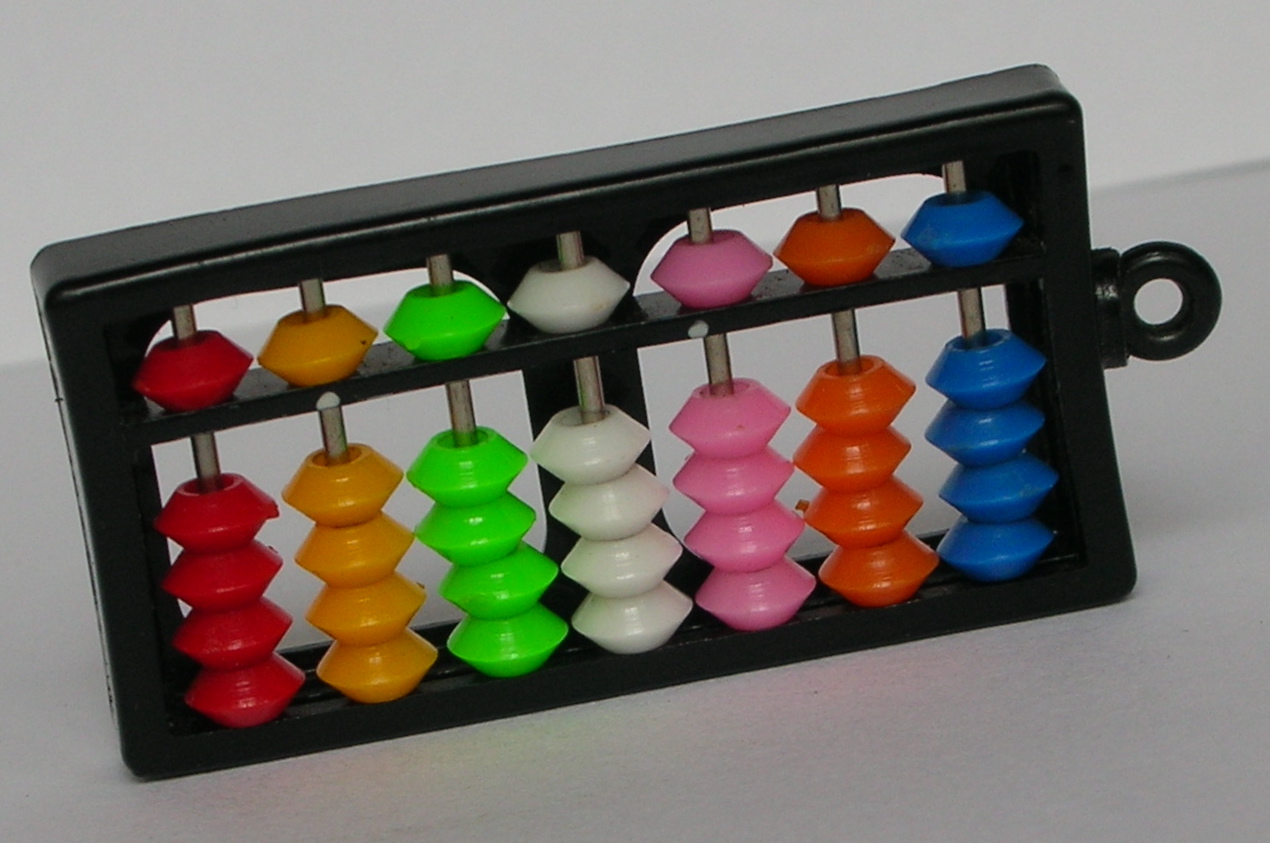
A 4 cm by 2 cm Soroban
Some years ago, I bought a small key chain that comes with a tiny golden-looking soroban (Japanese abacus). It never occurred to me then that this little ornament could serve as a divination tool for good luck. Today, it is not uncommon to see souvenir shops selling abacus-pendants (silver or gold bracelets, earrings, and the like) – some kind of amulets to thwart off any evil spirit, or some divination tool to attract success and prosperity.

So, the next time a friend gives you an ornament that comes with a cute-looking abacus as a gift, think twice before wearing it. You may unknowingly be the recipient of some superstitious or irrational belief that good luck is yours to come; or worst, if it's from some fiend or foe, you could be under the curse of some object of worship.

For reflection 

0. How would you reason with (or respond to) someone who faithfully believes that abacus-pendants are to be worn for good omen?

1. Give five reasons why people use the abacus as a symbol of prosperity and wealth.

2. What are some dangers in using the abacus as a divination tool?

3. How can you educate the public that wearing abacus-pendants as a sign of good omen will only promote pseudoscience and innumeracy?


For Mathepreneurs ONLY

1. Design an abaculator.
2. Improvise a solar-powered soroban.
3. Invent an electrified suanpan.

© Yan Kow Cheong, 26 August, 2010

Thursday, August 12, 2010

Aptitude Test for Math Editors

Senior and managing editors in local publishing houses have always lamented how hard it is to recruit decent mathematics editors, because CV’s and interviews often fail to filter the good from the mediocre candidates. On the other hand, few senior editorial staff dare to look in the mirror to see whether they themselves have what it takes to mentor or guide their editors. There is a Chinese or Japanese saying that says: "An editor shames her managing editor." The less-than-desired-quality of a published math book often reveals much about the competency of those behind its production.
 
Many years ago, I suggested administering a quantitative test to shortlist potential math editors interested in making publishing a career, in the hope that this may help reduce the relatively high attrition or casualty rate in the industry.

Below is a sample of questions we may pose to applicants keen on becoming word doctors in charge of mathematics titles, up to pre-university level.

A Test to Identify Math Editors

1. A writer approached two publishing houses for a manuscript she recently completed. The royalty rates are as follows: 


                       Publisher             Royalty rate

                                          A                    10% published price
                                          B                     12% net price
  
Net price is the price after 40% discounts to the bookstore.

(a) Which publisher should she choose?
(b) Another writer wants to know what percentage of the net price from Publisher B would yield a royalty equal to the published price from Publisher A. What percentage will this be?

2. Two publishing houses have the following mode of payments:


                 Publisher             Mode of payment

                              X                  $5000 + 5% royalty on published price
                              Y                  8% published price

Which publisher gives a better deal?

3. Due to the many errors in a geometry book, a printer had to replace pages 28, 29, 109, 130, and 131. How many sheets of paper did the editor have to reprint? 

4. Mathematics Digest, which has a special 16-page feature in the middle, is incomplete. The third page of the supplement (page 15 of the newspaper) is missing. What other pages must also be missing?

5. Four pages of one section of a newspaper are missing. One of the missing pages is 13. The back page of this section is 40. What are the other three missing pages?

6. When asked by her editor to add the page numbers of the section on Random Numbers he wrote, Mr. Goon said it was either 216 or 256. Which was it?
  
7. Ricky tore out several successive pages from an algebra book. The number of the first page he tore was 143, and the number of the last page is written with the same digits in some order. How many pages did Ricky tear out of the book?
  
8. The middle sheet is removed from a manuscript, handwritten on both sides of the paper. If the two sides are numbered 6 and 7, how long is the script?
  
9. Pages 6 and 19 are on the same double sheet of paper. How many pages does the newspaper contain?

10. A 60-page newspaper, which consists of only one section, has the sheet with page 7 missing. What other pages are missing?

Time limit: One hour 45 minutes for foreign applicants, or two hours for Singapore citizens and permanent residents.* 

If 75 percent were the passing mark for the above quiz, what would be the probability that half of the applicants who took the test would be shortlisted? How many could be considered a true-blue math editor or senior editor?

Two Standard Deviations from the Norm

In recent years, one recurring complaint among seasoned and prospective writers in academia and in schools, keen to write fertile math titles, is that we lack the local expertise or know-how in publishing quality or decent math titles other than locally approved school textbooks and workbooks. In fact, current editorial standards seem to be one or two deviations from the mean, as compared to what they used to be in the nineties.

The future of publishing decent math titles other than school textbooks looks uncertain, to say the least, as fewer ex-teachers are joining the publishing industry due to better job opportunities in other industries, where pay and promotion are much more attractive. Besides, there are few role models for novice editors to emulate should they choose to make publishing a career. Few math majors, if any, are in charge of math titles these days, and the editorial standards in a number of local small publishing houses (which churn out assessment titles like they're selling iPhones) leave much to be desired. 

Self-publishing on the Rise

Across the industry, editors' weak mastery of math concepts and poor linguistic skills would only aggravate an already-declining editorial quality of math titles. Most proofread instead of edit, or simply take care of the grammar instead of rewrite. In recent years, it isn’t surprising to witness many writers and authors switching to self- or vanity publishing, because few writers and teachers believe that there will be added value to their manuscripts, other than cosmetic improvements, going by the influx of assessment or supplementary titles inundating the local market every year.


A Third-class Industry in a First-class Economy
  
A common-sensical step in addressing the often-decried “Singapore-has-a-third-class-publishing-industry-in-a-first-class-economy” issue for its educational titles is to bring in better editors on board the editorial ship, or to recruit foreign talents who have worked no fewer than three years in established foreign publishing houses. Because little attention is given to the pay and remuneration, and to the opportunity to upgrade oneself professionally, the dearth of decent [math and science] editors isn't likely to reverse any time soon. A lack of passion and professionalism seems to be the currency of many editors these days. 

Singapore, a Publisher of Choice

As Singapore aspires to become a key player in math education publishing, local houses can’t afford to have math editors with an average knowledge of the subject matter and a below-average command of the English language. Having math editors with a mastery of the subject matter and a working fluency of linguistics isn’t an option if the country wants its math titles to graduate from a third- or second-class quality to match its first-class economy. And producing quality math titles other than school textbooks is the first sign or step to position Singapore in becoming an Asian publisher of choice in producing first-class math and math education titles.

* This apparent inequality is in line with the recent government's policy that Singaporeans come first, especially when it comes to providing jobs for locals and foreign residents.

 © Yan Kow Cheong, August 11, 2010.

Monday, July 12, 2010

A Singapore Grade Four Question Without Algebra


On 5 February 1999, Janey, an ex-colleague, forwarded me “Can U do a P4 maths question?”.

A farmer has twice as many ducks as chickens. After the farmer has sold 413 ducks and 19 chickens died, he has half as many ducks as chickens. How many ducks does he have now?


The above primary four (or grade four) question seemed to have been originated from an educated parent or university lecturer, who lamented that he was unable to solve it without algebra. How do you find the answer without having to solve an algebraic equation?


Before reading on, switch off your algebraic antenna for a while, and try to solve the question, using a model.

The solution given by the e-mailer is as follows:


To novice problem solvers, or to those whom the model method is a foreign heuristic, the thinking processes involved in drawing the correct model is seldom obvious. Even if you’re versed with the model or bar method, your model may be different from the one provided by the problem solver. 


Different models or methods

With some effort, one can come up with no fewer than half a dozen methods of solution. Other than the Chinese line and the Japanese Sakamoto methods, here are three commonly known ones, the first one being a slightly modified version of the above.  


Method 3: By Algebra


                                 Ducks             Chickens

Before                           2x                     x

After                        2x – 413              x – 19

Now,   2(2x – 413) = x – 19
               4x – 826 = x – 19
                        3x = 826 – 19
                        3x = 807
                          x = 807 ÷ 3 = 269
               2x – 413 = 2 × 269 – 413
                            = 125

So the number of ducks the farmer has now is 125.

The need for multiple solutions

In many problem solving books published locally, where the model method is the primary heuristic, few writers had provided more than one method of solution. Whether it’s due to space or time constraint from the editorial side, or because of little or no conscious effort on the part of the problem poser, to look out for alternative models, is hard to tell, especially when not many who edited or wrote those questions had had first-hand classroom experience with students who struggled with constructing those models.

It isn’t uncommon to encounter these typical questions in the Singapore Mathematics Olympiad for Primary Schools, and from the exam papers of the better local primary schools, whereby a model solution, or some intuitive method, is expected. Such problems, which would normally be solved by algebraic means at a higher level, could now be tackled using a model, when set at a lower level.

We fail to realize that these challenging questions are often constructed backwards, so that we can force the numbers to fit themselves nicely at each step of the working. No wonder even experienced primary and secondary school (elementary and middle-school) teachers are challenged to solve these word problems sans algebra. Failure to be aware of this may otherwise lead many qualified teachers to feel inadequate in tackling these non-routine questions, especially when a non-algebraic solution is expected.

Filtering the nerd from the herd

The disturbing fact about using the model method is that many schools (not just the better ones) in Singapore use these “Section C Problems” to unfairly identify and stream students into the good and bad classes⎯the A-, B- and C-band and the rest, where the students are presumably less academically inclined. So if you can’t cope with (or are allergic to) those word problems whose solutions are best solved using a model, then good luck to you! Your score on these word problems is often used to gauge how good you are in mathematics. 

The worst happens when teachers themselves aren’t confident in solving these word problems. What they usually do is to leave confused students with some sketchy modeled steps, often worked out by underpaid undergrads, as hints or partial solutions to questions that are extracted from unauthorized (pirated?) exam papers.

© Yan Kow Cheong, 11 July, 2010

Monday, June 21, 2010

Football Freaking, Anyone?


Gary Rimmer defines “number freaking” as a way of looking at the world through the lens of numbers. Unlike guesstimation (a marriage of the words “guess” and “estimation”), which tends to be more serious and school-based, number freaking is like doodling with numbers, in your head, just for fun – just like playing jazz math!

In this season of football fever, it’s important to strike a balance between your eyes and your brain. Resorting to some football freaking, by exercising your mind’s eyes, could only do good to your brain cells, instead of just sitting there for hours and days as professional couch potatoes, consuming all those sinful foods and drinks, which you 'promise' not to touch except every four years.

One goal of practicing football freaking is that it will reveal things you didn’t know you didn’t know. So, are you ready for some guesstimation, speculation, and extrapolation? All you need is a calculator, unless you’re a certified mental calculator, of course.

Let’s begin with a taste of these surreal computations behind the beautiful game.

The richest player in England is reputed to be David Beckham, said to be worth some 20 million pounds (including endorsements) a year. How many Beckhams are worth a Tiger Wood?

What are the odds that North Korea would make it to the last 16 in the World Cup 2010?

If David Beckham decided to play for a Singapore team, how much earnings would be generated in shirt sales?

How many man-years of average South African or Algerian productivity would it take to pay England’s goal-scorer-in-chief, Wayne Rooney, his salary during a month at the World Cup?

In North Korea, how many average workers’ monthly salaries will it take to pay the airfares of the local team to South Africa?

How many extra liters of beer will the South Africans need to brew to satisfy the fans for a month?

What percent of games will end 0:0 after 90 minutes at the 2010 World Cup?

On average, what would be the distance (in kilometers) the players in each team covered collectively in a World Cup game?

Since it began in 1930, how many kilometers have been run at the World Cup so far?

Historically, how many goals are scored on average in a World Cup match?

How many men might die of a heart attack if Brazil, Germany or Spain didn’t qualify for the last eight?

How many football fans have ever attended a World Cup match?

How many times could the ball travel up and down a 110-yard pitch in 90 minutes?

What could be the potential “black-market” value of all the spectator tickets in the World Cup 2010?

How much is the illegal football betting in Singapore worth during this World Cup 2010?

How many divorces might result from wives refusing to let their husbands watch football matches during the World Cup 2010?

How many tens of thousands of football fans in Singapore couldn’t enjoy (or afford to subscribe to) the World Cup 2010 matches, because they refuse to pay the over-priced ninety-odd dollars charged by service providers to watch the other matches, besides the free-telecast semi-finals and the final?

If you've fallen in love with football freaking, and should you decide to train yourself to become a professional football freaker for FIFA (indeed, they'd create this new post for World Cup 2014), visit the Website www.footballfreaking.co.uk for more challenging sums on the beautiful game.

Reference

Rimmer, G. (2006). Football freaking: Surreal sums behind the beautiful game. Icon Books.

© Yan Kow Cheong, June 20, 2010

Thursday, May 27, 2010

LIFE and DEATH by Numbers

LIFE and DEATH by Numbers

One of Singapore’s founding fathers, Dr. Goh Keng Swee who was Mr. Lee Kuan Yew’s Economics tutor, and later his deputy prime minister, died at the age of 91 on May 14. And one of the best-known popularizers of recreational mathematics, and debunker of paranormal claims, Mr. Martin Gardner died at the age of 95 on May 22. Both men were blessed with a lifespan of more than four scores and ten, and hundreds of thousands of people benefited from those two selfless men’s contributions.


Some two decades ago, I bought a copy of Gardner’s book from an ex-colleague, and since then I had never looked back to enjoying the beauty and power of mathematics. Like thousands of Martin Gardner’s fans around the world, formal schooling often fails to expose us to the joy and beauty of mathematics, so when I first read Gardner’s Mathematical Carnival, it was numerical love at first sight.

Let's popularize and evangelize math

Many of us love math in school, because we simply like solving non-routine or challenging word problems, or we enjoy being challenged by logic games and puzzles, but few things come close to getting a glimpse of the beauty and utility of advanced math, as popularized by Martin Gardner for number addicts of all stripes.

Death is blind

Dr. Goh and Mr. Gardner were men of numbers who contributed much, and many of us reaped the fruits of their labors. As we ponder on their numerous outputs, it’s never too early for us to reflect on our own mortality, and what our 'mathematical legacy' would be when we too reach the end of life’s journey.

You’re just a heartbeat away!

You’d even die before you finish reading this post. I’d die while you’re reading it. Now! At this very moment! It’s easy to be preoccupied with our to-do (or not-to-do) lists, focusing on our teaching, writing, reviewing, or preparing for our next meeting. We go on our normal lives as if we've thousands of days or millions of hours left before our last breath. We don’t want to think that we’re all one heartbeat away, regardless of our position or station in life.

We operate on automatic mode: Today it’s just a normal day to do whatever we feel like doing. We forget that we’re a mist that appears for a while and then vanishes. We don’t want to admit that today we may die. Or, maybe we feel invincible that nothing mortal is going to affect us. We live as though our lives would go on forever. We’re like the foolish rich man who thinks like “Today or tomorrow I’ll travel or fly to that city or country, spend a few weeks there, carry on my business and make money,” not realizing that his life will be taken away the very night.

If we live up to three or four scores and ten, it’s hard to accept that by then no one will care what positions we held, how many titles we collected, how many books or articles we wrote, or which conferences we attended.

Live and work selfishly or selflessly 

People die while living and working selfishly. At your funeral, will colleagues and social media friends attend it to stretch the truth in order to make you look good, or to sound as if you’re not that mean, after all? Nobody would dare say an unkind word at that last gathering; there is an obligation or pressure to come up with something positive to say about the person who died. But we secretly think the same thing: He or she really wasn’t that great of a person or boss or politician.

Plan your eternal destiny now

Unless we realize that we’d be the next person in our family or company to die, we wouldn’t see why we needed to treat our colleagues well. We’ve to believe it enough that it changes how to live. To say NO to office politicking and scheming, to start treating our colleagues whom we don’t like decently and fairly, to accept others in spite of their idiosyncrasies, to recognize that we’re not as smart as we think we’re, or that we’re not above-average as we want others to see us. 

Think of your obituary and eulogy

Unless we’ve a holy fear of God who holds the key to life and death, we’ll foolishly live our professional or working lives as if we can earn our eternity by merely living decently; yet our hearts and minds are far from Him. We try to do or act good to get His attention, but the condition of our hearts remains deceitful and evil. May the Holy Spirit reveal the sinfulness of our minds and hearts!

Some earthly thoughts on the heavenlies and Hades

Let me close with some life-and-death thoughts, dressed in some quasi-numerical language.
 
Life is a canvas of if’s.
You are what or how you count!

Life & Death

The probability of one’s living up to 444 years old is 0.
The probability of one’s dying is 1.

Life after death

The probability of going to he** is ½, where ** depends on how lean or mean you’ve been to your fellow mortals.

The probability of being reincarnated is 0.
The probability of being resurrected is 0.0000…1.
The probability of being cremated in crowded Singapore is 1/100,000.

Death after life

The probability of living for eternity [heaven or hell] is 1.
The probability of living in purgatory is zero – it’s a cardinal myth.
The probability of being in a Who’s Who in Hell list is exponentially higher than you think.
The probability of being in a Who’s Who in Heaven list is infinitesimally lower than you think.

Born twice, die once – eternal life
Born once, die twice – eternal death
  
The probability of dying twice [physical and spiritual deaths] is 1 × 1/x.
The probability of dying once [physical] is 1 × ½.
The probability of being  “born again” is about 1/15 – based on the number of residents-believers in Singapore.

It’s better to be born twice and die once than to be born once and die twice.

The chances of eternal life depend on your faith in His earthly death.

A lifespan of three scores and ten (70) lasts about a billion seconds.
Would you like to be blessed with a four-scores-and-ten lifespan? 
Then start honoring your parents. 

The probability of living up to 70 years old is 0.7.

The probability of living up to four scores and ten (90) is 0.1.

The probability of living up to five scores and ten (110) is 0.000,000,000,000,1.

On earth he was grounded to infinity
In heaven he was lifted up to eternity

Life is fair
Death is a great equalizer for rich and poor, smart and dumb, strong and weak, arrogant and humble, etc.

For partial proof
Dig six feet deep

Poor Fermat lied about his proof           
So the devil sent it to Prof. Wiles

You and faith = heaven
You and fate = hell
      
Dead Mathematicians: “Stop counting, we ‘re not getting up.”

In his prime, he worked on primes
In eternity, he rested in solitary

Life is the gross common differentiator (GCD) between rich and poor.
Death is the least common denominator (LCM) for all rich and poor.
           
A Christian dies twice but lives once.
An atheist dies once and lives once.

Live truthfully so that your pastor doesn’t have to lie about you at your funeral service.

Atheist: Heaven? No. Hell? Maybe, black hole?

Why are there only a low percent of mathematicians and math educators who go to heaven?
If they all went, it'd be hell!

Eternally yours

© Yan Kow Cheong, May 27, 2010

Thursday, April 29, 2010

SUDOKU for Goondus and Suakus

The Sudoku fever has subsided significantly from the time one could witness dozens of teenagers and working adults (and even some seniors) on morning and evening trains and buses, frantically trying to fill in the empty squares from sudoku puzzles published in newspapers or paperbacks – it looks more like some self-imposed or self-inflicted deadlines to complete the puzzle before they reached their destinations.

However, the cult of diehard sudoku addicts has kept the world’s number-one logic puzzle alive, with publishers never failing to inundate an already-saturated market. Recently, I visited Borders, Kinokuniya, and some local bookstores to have an idea of the number of sudoku titles each one carries. Not surprisingly, the Japanese bookshop has an entire shelf dedicated solely to sudoku titles.

A common sight at these locations is the number of recreational math and science titles being outnumbered by sudoku titles under the Puzzles/Games section. In terms of shelf space, only feng shui, numerology, and other New Age titles (subtly promoting pseudoscience, innumeracy, and fear) seem to be able to compete with sudoku titles (indirectly marketing logic, numeracy, and sanity) these days.

Let’s look at some of these creatively christened titles sold in Singapore bookshops:

Killer Sudoku
Mastering Sudoku
Absolute Sudoku
The Original Sudoku
Extreme Su Doku
Hard-As-Nails Sudoku
Expert Sudoku
Mammoth Book of Sudoku
The Big Book of Sudoku
The Little Book of Advanced Sudoku
Sudoku Genius
Stylish Sudoku
Chic Sudoku
FEROCIOUSLY FUN Sudoku
Super-Smart Sudoku
Su Doku Gold/Silver/Platinum
White/Brown/Green/Black Belt Sudoku
Third-Degree White/Brown/Black/Green Belt Sudoku
Su Doku For Dummies*
Sudoku for Dummies
Extreme Sudoku for Dummies
Kids’ Sudoku for Dummies
Sudoku Jokes (Easy/Difficult)
Tough SUDOKU
Sudoku GRAND MASTERS
Sun, Sea AND Sudoku
Sudoku Shite

Like timesharing sales personnel, writers and publishers of Sudoku titles are never short of creative titles to keep the craze alive. Like the 15-Puzzle and the Rubik cube, Sudoku may be just a fad for some, but one thing we can learn from the rich list of sudoku titles is that there is more than one creative way to market the same old content to tens of thousands of lovers of logic puzzles. Probably, creative publishers and writers could substitute ‘sudoku’ by ‘math’ in the above list to capture a bigger market for their future math titles.

While some of us are waiting or hoping for some non-vanity publishers to approach us to write or co-write some Sudoku titles for some Asian young (and senior) audiences, in particular the X and Y generations, let me leave you with a list of titles, which may be worth publishing.

I doku, therefore I am
Sudoku for Seniors
SUDOKU for Priests, Pastors & Pro...
Sudoku à la Singapour
The Asian Sudoku Calendar
Kung-fu Sudoku
A Model Approach to Mastering Sudoku
Sudoku-Lite
Why Sudoku May Be Bad for You!
Why Men Doku and Women Don’t Q
Doku your babyBe the next Euler!
Lucifer sUdOkU
Sudoku 4 Lovers–Play in Pairs!
The Hype about Sudoku
The Lighter Side of Sudoku
Sudoku for Kiasus⁺
Sudoku for Dementia-Prone Citizens

Sudoku-fully yours

Suakus and Goondus are the Asian equivalents of Dummies, Idiots, and Morons.
* I only have a vague idea how Su Doku for Dummies differs from Sudoku for Dummies.
 Kiasus are those who are afraid to lose out in life.

© Yan Kow Cheong, April 28, 2010