Welcome to K C Yan's Singapore Math blog!

Wanting to be updated on Singapore Math news or new Singapore Math? You have come at the right place! Please leave your comments before leaving. A googol thanks.

Singapore Math

Sunday, October 4, 2026

Malaysia Math

SG-Friendly Ex-PM

Nabbed Najib pardoned
by King for kleptocracy—
will SG fund him?


Art by Daniel Murphy


Among Malaysian prime ministers, Najib Razak is arguably the most Singapore-friendly one.

Corrupt yet still seen as “competent,” it’s no surprise that Najib remains popular both at home and abroad.

Like comrade Trump, Najib too used the race-and-religion trump card to win votes among an often semi-innumerate or diehard electorate who were promised lots of goodies if he became Head of State.

The recent controversial royal announcement that Najib be allowed to serve his remaining jail term at home if he pays the RM50 million court-imposed fine has drawn both sarcasm and support from netizens.

Najib’s house arrest is good news for jailed white-collar criminals. It pays to take bribes, then use a fraction of the “corrupt zeros” as a fine so as to serve the rest of the sentence at home.

If only Malaysian prime ministers had been like kings and presidents who could pardon crooks, criminals, and murderers by using DJT’s money-making “pardon template,” ex-PM Najib could have become a Ringgit trillionaire long before Elon Musk.


Political Math

The “Najib Razak Solidarity Fund,” organized by his United Malays National Organisation (UMNO) party, has also been fertile fodder for math educators who recreationally pose real-life math problems to tickle their mature students.

Three such politically incorrect math questions are:

1. Political Math: If a towkay donates 1 sen on the first day, 2 sen on the second day, 4 sen on the third day, doubling the amount each day, on what day would all the donations exceed the RM50 million fine to free ex-PM Najib from jail?

2. Solidarity Fund: What are the odds that some MPs and ministers in the “fine” city-state might secretly donate to UMNO’s “Najib Razak Solidarity Fund” to help Singapore-friendly ex-PM come home?

3. Poverty Fund: Guesstimate how many homeless people or illegal migrants in rural Malaysia a RM50,000,000 fine could feed in a week.


Photo: Facebook/James Chin


If you’re moved to forgive a white-collar inmate, or think that Bossku has unfairly been politically targeted by his foes, the donation drive to transfer him from prison to house arrest is alive. It’s not too late to help pay his bigly fine. One sen on day 1, two sen on day 2, four sen on day 3, … will go some way toward getting him released sooner rather than later.

Gracefully & generously yours


Performance Politics

Bossku go home
I sure resign one
I go home too lah

© Yan Kow Cheong, October 4, 2026

Sunday, June 29, 2025

Does AI Sulk at Counting?

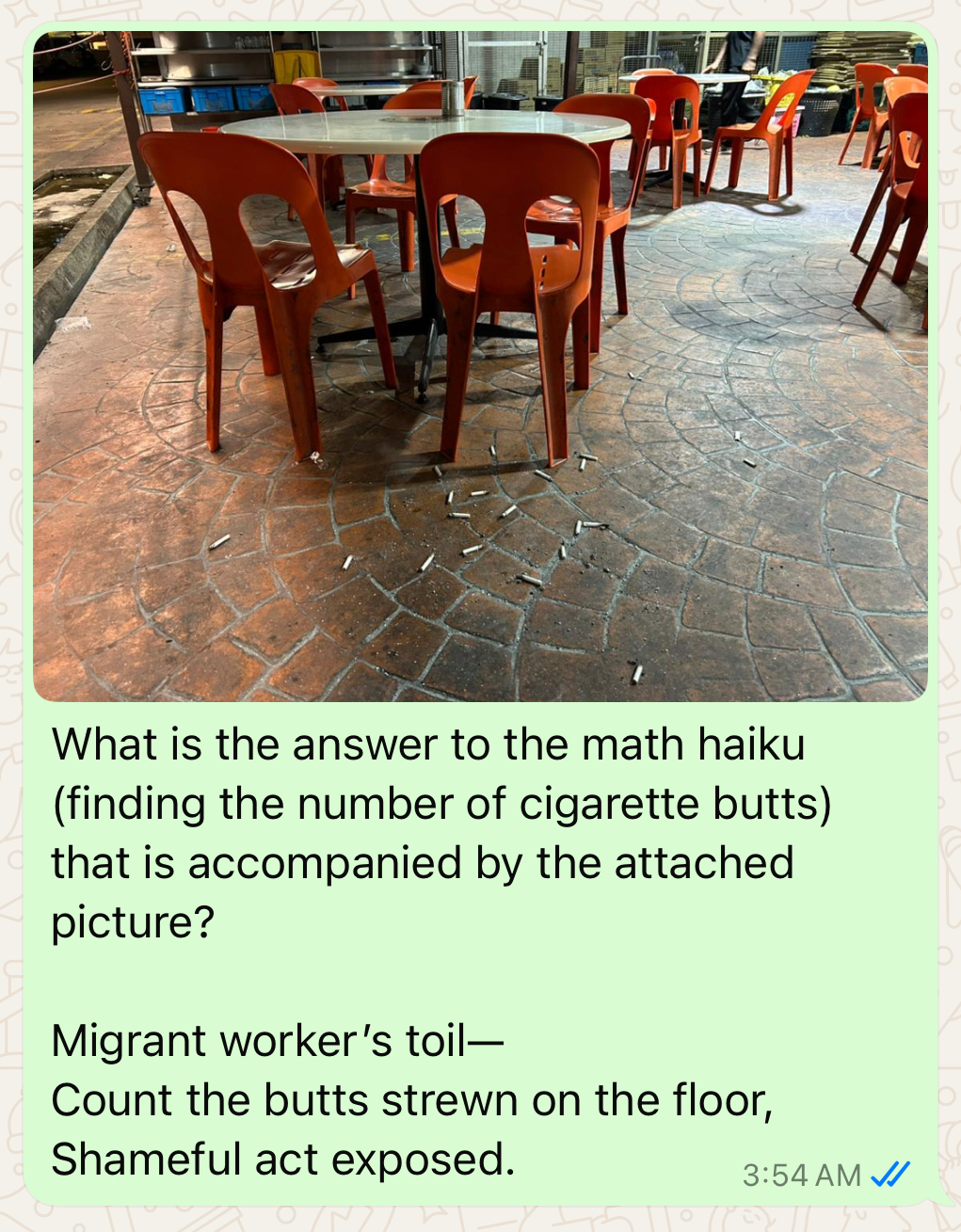
Six days ago, in the wee hours at a 24/7 neighborhood coffeeshop, I spotted the unsightly aftermath of a chain-smoker’s bad habit. Below is a shot of its dirty floor:


While sipping my tea, it crossed my mind to convert that Ugly Singaporean’s behavior into a math question in the form of a haiku.

I crafted the maiku tongue-in-cheek and X-ed the following:


The Ugly Singaporean

Migrant worker’s toil—

Count the butts strewn on the floor,

Shameful act exposed.


A few days later, for no reason, I was prompted to ask AI for the number of cigarette butts on the floor.

Below are the exchanges or arguments I had with my virtual math teacher.


At 26, I decided to end the conversation, albeit I believed that with some persuasion I’d have tricked AI to agree with me that the answer could be 10π.

Now, it’s your turn to tell us the exact number of butts, by outsmarting AI. What’s the correct answer?

Humanly yours

© Yan Kow Cheong, June 29, 2025.

Monday, January 6, 2025

The Singapore Mathematics Calendar

Not Your Average Math Calendar!

Even if you’re not a tiger mum or dad, there is no better way to usher in the New Year, by blessing your child or a loved one with the quirky and colorful Singapore’s Maths Calendar 2025.

Literacy & Numeracy

Singapore’s locally published and printed “first of its kind” math calendar aims to kill two birds with a mathematical stone, by helping your little one become both literate and numerate in the shortest time.

With a new math question every day—the answer is the date on which the question is posed—offers a creative way for grades 1–2 (or primary 1–2) children to learn math, while having fun along the way.

Plus, the questions have been painstakingly set in such a way that they follow closely and timely the topics or concepts that are presented in the students’ MOE-approved textbooks and workbooks. Yes, even during the school holidays, calendar users’ daily mathematical diet is being taken care of.

Enrichment Math via Comics

With a monthly comic story that promotes biodiversity so that the younger generation would still have a planet to inhabit when they’ve their own children and grandchildren, Singapore Maths Calendar 2025 also aims to educate young readers about Singapore’s wildlife, while learning some fun facts about birds, mammals, reptiles, and sea creatures native to the island state.

Available at all major bookstores and local school bookshops

Publishing a Math Calendar

For aspiring mathepreneurs or seasoned math writers, who desire to produce a similar calendar for other grades or editions in 2026 and beyond, you might think twice or thrice before embarking on such a “deceptively easy” math project.

As I hinted earlier, as a writer, if you want to write a salable math title that would pay the bills (or one that might even help you retire prematurely), writing an assessment or supplementary math title has a higher chance of fulfilling your short- or medium-term goals than working on a [Singapore/Singaporean] math calendar.

At best, writing and publishing a math calendar might temporarily boost your ego, but based on my experience working on these tricky pet math projects, I’d recommend that you spend the man- or woman-hours producing a few no-frills assessment or problem-solving or recreational math titles instead—if you long for some decent royalty or pie-in-the-sky lump sum payment.

For the publisher, producing a math calendar, especially in ever-dwindling birth rate Singapore, the risks (and costs) are pretty high. For the writer, the much-longer time and oft-unappreciated effort needed to write a math calendar could be better spent teaching, tutoring, editing, or writing more salable or profitable assessment titles.

From a business standpoint, 98% of publishers would rather focus their energy and deploy their manpower on producing profitable titles than meeting the mathematical needs and wants (or satisfying the ego) of their calendar math writer. Moreover, from the editorial and production angles, churning out a math calendar could be frustratingly painful and technically challenging, compared to producing a typical assessment or supplementary title (or even an oft-ill-edited primary school textbook).

Count on Singapore! 

The Singapore Maths Calendar 2025 is not only a Christmaths gift for 6–8 year olds, especially those who’ve an ambivalent attitude towards the subject, but also an aha! souvenir for any traveler to the “fine” city of Singapore. An apt [nonboring] Singapore math gift to bless a loved one at home!

Be a part of the Singapore math diaspora, while having a good idea of the mathematical standard expected of most local students. The calendar’s must-do or must-practice math questions allows you to gauge your child’s level of mathematical proficiency vis-à-vis their counterparts in Singapore, where even their weaker students have so far fared better than the global average. 

For the price of two McDonald’s meals or less, with a yearlong supply of 365 routine and nonroutine math questions, plus 12 months of comics stories, there is probably no present Singapore math assessment title, enrichment or not, that offers the average or above-average student a wallet-friendly rich mathematical experience quite like the Singapore Maths Calendar 2025.

Trust not my words! See for yourself whether or not this math calendar-cum-assessment-book is worth a good educational investment for your child or homeschooler in 2025.

Bonus: A math problem a day could keep the tutor away!


Calendrically & mathematically yours

© Yan Kow Cheong, January 6, 2025.


Singapore Maths Calendar 2025 at Kinokuniya and Popular bookstores

Monday, December 2, 2024

Calculus for Babies


A quarter-odd century ago, I came across Donald Cohen’s Calculus by and for Young People (Ages 7, Yes 7 and Up) (1989). The co-founder and teacher of The Math Program subscribed to the philosophy that children are capable of behaving as (little) mathematicians.

Apparently, kids could be exposed to a quasi-formal treatment of integration and differentiation without an ∫ or a dy/dx.

Little could I divine that three and a half decades later a physicist-mathematician-turned-science author would tease tiger or kiasu parents with his Calculus for Babies.


Photo © Anon.

Cal 4 Babies & Toddlers

After Chris Ferrie’s Pythagorean Theorem for Babies came out in 2022, I knew that it’d be just a matter of time before the author would give us Calculus for Babies (2024), under the “bestselling” Baby University series.

Two days ago, I finally laid my hands on the anticipated title, which claims to introduce babies (and reminds grownups!) to the basic concepts behind calculus, arguably “explained in an easy-to-understand and fun way!”

Sounds like when you’re a mathepreneur, no audience is ever too young to learn the basics of any abstract or advanced math. Or the unspoken assumption that nurturing a little genius at home is possible even if your baby isn’t born or blessed with the “mathematical gene.”

Yes, it seems that it’s never too early to become a mathematician or scientist (as long as you’d afford to pamper your child with the [best?] oft-dear math titles or resources).

Before Ferrie’s Calculus for Babies was published on July 2, 2024, Esmond Cooper had come with a similar title on June 28, 2023. Debatably, Cooper’s “simplified guide introduces young minds to the fundamental concepts of calculus in a way that is clear, engaging, and accessible.” 

Cooper’s Calculus for Babies “aims to make learning enjoyable and foster a love for math from an early age, providing a strong basis for future mathematical understanding.”

After the success of sexy titles like Calculus for Cats (2001) and How to Teach Quantum Physics to Your Dog (2010), publishers probably bet that the next wave of pop math titles targeting parents who think that they’ve been blessed with a “talented or gifted” child should focus on calculus—and for unknown reasons not on algebra or geometry or trigonometry.

Interestingly, as far back as 2011, Omi M. Inouye had published a 54-page Introductory Calculus for Infants, which is about the mathematical adventure of two buddies as they discover the wonders of calculus.


From Beethoven to Newton & Leibniz 

If pregnant women are already playing classical music or reading bedtime stories to their unborn, it’s not preposterous that in a-not-too-distant future, some pre-rich writers or publishers would give birth to Pre-Calculus or Calculus for Your Unborn Child.

Just because calculus is the bête noire of college math, it doesn’t mean that your [talented, gifted, or blessed] newborn or toddler or preschooler can’t handle it. They can if you think they can!

Differentially & integrally yours

© Yan Kow Cheong, December 2, 2024.

Monday, October 14, 2024

Murderous Pi


Political Pi
 

When π thought that she’d never want to be associated with gun violence and senseless death, was she just being politically positive or naive?

Pi’s fear has now come true. Without repeated funding from gun manufacturers and pollution-enabled organizations, an obscene number of morally corrupt halfwitted lawmakers in TrumpLand would never get elected or reelected.

Even as you’re reading this, the odds of another senseless shooting or tragedy currently being witnessed in some red-pilled states are anything but zero.

It looks like if only those GOP selfish lawmakers and their loved ones or friends were the victims, maybe then they’d eventually do something about gun control; otherwise, it’s all NATO (No Action Talk Only).


Should Math Teachers Be Armed?

The Blame Game

People are sick of hearing the years-long canned story from inept and morally bankrupt politicians, who simplistically blame mental health, inequality, racism, or whatever social ills, rather than the free flow of guns for the recurring senseless deaths. It’s like the political equivalent of scapegoating the forced learning of algebra for the nation’s high innumeracy rate.

The U.S. is the only “civilized” nation in the developed world that has continually shortchanged its schoolchildren and their teachers. When profits and politicians triumph over principles and people.

Or, only in TrumpLand do we read about these senseless school gun deaths—when students shoot teachers and their peers because they can do it. And those preventable school shootings have only got more frequent and resulted in higher casualties in recent years.


Murderous Statistics

Below are some “murderous statistics” I’d tweeted over the years following numerous school shootings:

Sadistic Statistics from the National Rifle Association (NRA): “No guns, very high murder rates; more guns, very low murder rates.”

Murderous Math: People in the U.S. are 20 times more likely to be killed by a gun than someone else in another developed country.

Gun Ownership: Singapore ranks among the bottom 10 for the number of privately owned guns per 100 people.

It’s said that the chance of a 15-year-old boy dying by the age of 50 is now higher in America than it is in Bangladesh. The odds might even be higher now with Trumpism and moral bankruptcy plaguing Trumpublicans.

Deadly Statistics: The positive correlation between the coronavirus and the growing gun sales in the U.S., which has the highest crime rate in the developed world.


Dark Problem Solving

Ironically, school and gun shootings in the U.S. have provided math educators with real-life math problems, which could be used to hone students’ guesstimation skills. Two such questions are:

Political Math: Guesstimate how many “corrupt zeros” Trump and his billionaires-donors (and the mostly morally corrupt GOP lawmakers) pocketed, by protecting profiteering guns, insurance, and pharmaceutical companies.

Death Statistics: How many students in the U.S. senselessly die every year from gun violence?


No Gun Reduction, but God’s Protection


Let’s end with a haiku I recently X-ed in the aftermath of Trump’s lackey saying that school shootings are a “fact of life.”

Serial School Shootings

Money politics
that support gun businesses.
That’s a “fact of life.”


If the U.S. is dead serious about protecting schoolchildren and teachers from gun shootings, maybe it’d do it the Singapore way: Zero tolerance for gun sale to 99.99% locals. Vote out politicians who’re funded by weapon manufacturers.

Safely & securely yours

© Yan Kow Cheong, October 14, 2024.

Friday, September 27, 2024

Risqué Math Cartoons

 @pickover on 9/23/24

What about a math joke that could in itself be treated as a kind of math joke? A so-called metamath joke.

Admit it! It’s not uncommon that sometimes it takes a while before you can get a math joke, especially if it relies on some basic knowledge of advanced or abstract (or abstruse) math.

Experiencing that aha! takes a little longer. For novices, a mature or sophisticated math joke wouldn’t spark much mathematical joy in them—it seems or sounds more like a boring math textbook or a vanilla math teacher than anything else.

Of course, there are some math jokes that are open to different interpretations, especially those bordering on poking fun at “oft-proudly self-professed nonmath” or semi-innumerate folks, which may arguably be perceived as being elitist, racist, or sexist (or all three) in some illiberal or puritan circles.

Cartoon by Mike Seddon

MAGA Math (or Haiti Math?)

Below are two political math jokes I recently X-ed in the aftermath of racist rhetoric perpetrated or repeated by a white supremacist, who once proudly self-proclaimed to be the “least racist person on the planet.”

Political Algebra: A MAGA equation that could lead to the loss of millions of conservative votes, as people have had enough of racist or nativist language, which divides rather than unites a polarized nation.

An equation à la Trump

Dog Math: How not to submit your math homework—thanks to Trump and Vance and MAGA ambassadors of bigotry, who forget that they themselves are the offspring of immigrants. Estimate how many millions of kids would get away from this racist excuse.

My Dog Stole My Homework (Again)

These days, it’s getting harder to share a math joke or a quasi-clean limerick without being labeled with all kinds of four-, five-, or six-letter adjectives in the “cancel culture” or “woke” world we live in.

Are the days of adult or mature math jokes numbered? Is vintage recreational math found in out-of-print math puzzles titles, periodicals, or journals—which is often inarguably colonialist, racist, or supremacist—heading the way of the dodo?

Humorously & irreverently yours

© Yan Kow Cheong, September 27, 2024.


Facebook’s “UK Best Jokes & Puns” (Feb. 13)

Thursday, June 27, 2024

Is Age Just a Number?


Cartoon © Anon. (being memeified)


I admit that I’m guilty of ageism, but I make zero apologies for exposing criminality or hypocrisy, especially among (past and present) heads of state.

For the majority of us, oft-reluctant law-abiding citizens of the world, few would admit that the criminal mind is a “creative” mind in disguise—one that we’d learn a thing or two from if we put aside our prejudices.


A Tale of Two Senior Presidential Candidates

What are the odds that the world might soon witness a presidential debate between a patient and a prisoner? If reelected, could either folk serve his full term?

Arguably, we’ve two power-hungry weak “leaders” that America could do without—when both seniors should be grandfathering (or con-sulting) rather than mis-leading or weakening the country for another four years (assuming their Creator doesn’t call them before their term is due).


Cartoon by Rick McKee (@Rick_McKee_Ink)


An Age Limit for Presidency

If the present president and his predecessor are too old to competently serve the challenges or demands of another term, shouldn’t lawmakers pass a constitutional law that no elected president shall be of a certain age on the date of inauguration?

What should that age limit be so that voters feel comfortable that any elected presidential candidate would fulfill his or her responsibilities of office? 65, 70, 75, or some other age?


Bitter Root ≡ Better Fruit?

If a bad tree can’t produce good fruit, it’s preposterous to see millions of voters expect a serial dishonest or corrupt “I-me-myself” candidate to deliver them from their years-old financial, social, and religious ills.

The theological or political argument that voters shouldn’t put too much emphasis on a candidate’s past manifold wrongs (who’s continually denied any wrongdoings) to assess or judge him sounds dangerously frightening. Understandably, the criteria to electing a president must be much lower than those used to choosing a pope. Really?


Cartoon by @DennisGoris (buff.ly/3VlEyaz)


King Saul 2.0

What are the chances that in Biden or Trump, we’d be witnessing a modern-day version of King Saul, whose rule would be cut short? Would those mostly morally bankrupt or corrupt appointees, who condone their lies and falsehoods, expect to operate in a blessed political environment? It looks more likely that political entropy would be the new normal come January 2025.

In politics, irrationality and hypocrisy often prove that a string of wrongs has near-zero bearing on the electability of a corrupt or rogue politician.

When one senior isn’t much younger than the other, the choice isn’t that difficult. You choose the one with (more) character, humility, and honesty. Voting for the alternative is flirting with ineptitude, dishonesty, and chaos—more pain and suffering for the majority of the population, who expect their next president to behave more like a priest or pope.


US Math: An Age Problem

Let’s end with a birthday joke on the two most senior presidential candidates in U.S. politics:

Q: Why even their diehard supporters see both Biden and Trump as old, who should be banned from taking part in a presidential election again?

A: At their last birthday, the candles cost more than the cake.


Electorally yours

© Yan Kow Cheong, June 27, 2024.

Monday, April 22, 2024

Thou Shalt Keep the Mathematical Sabbath!


The Weak Days of the Week


It’s said that working seven days a week makes one weak. Even workaholics who often wished they had an eight-day week couldn’t go on their routine hoping to ever be productive or creative sans experiencing a breakdown sooner than later.


Four-Day Work Week

Recently, there was much talk in the “fine” city about a four-day working week. Sounds like good news for tens of thousands of employees, especially those in the civil service, but bad news for profits-over-people employers or bosses in the private sector, who don’t subscribe to a workplace promoting a less than a 44-hour work week.

A recent poll found that around a third of Singapore workers surveyed expect a four-day work week to be the new normal in the next five years, with about twenty percents of them saying that their employers already offer such a work arrangement as an incentive to promote mental health at work.


Three-Day Weekend

What if schools switched to a four-day week? Would productivity (and creativity) for teachers and students go up? Would parents (and tuition or enrichment centers) support it?

Would the Ministry of Education dare to entertain such an idea in a tiger economy? As Singapore has evolved from a stigma-based streaming to a socially acceptable subject-based banding (a refined version of streaming) education system, it’s not a far-fetched idea of allowing students to come to school for just three or four rather than five days a week.

After all, the aftermath of Covid-19 had given them a foretaste of what schooling or blended learning might be in future, without depriving them of a formal education. A case of “less is more,” just like the politically correct “Teach Less, Learn More” mantra.


The Sabbath Mode

It’s never too late to put yourself in a Sabbath mode. You needn't be religious to see the benefits of the Sabbath—a mind-set that those in demanding jobs appreciate.

Think of those domestic workers in Singapore, whose employers expect them to work seven days a week, even if the Ministry of Manpower has mandated a one-day off for them every week.


A Mathematical Sabbath à la Singapour

Due to lack of understanding or wisdom, for a large part of my student and working life, I was often guilty of paying lip service to keeping the Sabbath, hoping to maximize my studying time, or minimizing my sleeping or resting time. A short-term success formula with long-term costly results.

Below is an attempt to define what a “mathematical sabbath” might entail for math educators around the globe, who long to be at their creative or productive best, week in, week out, without cutting corners on their rest or quiet time.


Your Mathematical Rest Day


Which Weekday Are You In?

On average, we’ve a three-scores-and-ten lifespan, or 70 years. If every day lasts a decade, which day of the week in your life are you in?

Sometimes God gives us an extra Monday, Tuesday, or Wednesday. How many souls do we want to bring along for the remaining days we’ve left with?

On a similar note, recently, I semi-poetically X-ed (or tweeted) the following:


@MathPlus on 3/28/24


Remember the keep the Sabbath day holy—and also the mathematical sabbath wholly.

Restfully & creatively yours


© Yan Kow Cheong, April 22, 2024.

Monday, February 19, 2024

Thou shalt not use an arrow for an equal sign!

Shot from Tiesha Sanders/Facebook

The above grade one math question from Texas is debatably ill-posed. However, the child answer of “7 ones” is “non-mathematically creative” or “irreverently correct.”

The teacher’s reply to the mother that “… this is the new math they have us teaching.” would puzzle many math educators outside TrumpLand. Arguably, the correct answer to this routine question has little or nothing to do with “new math” or “new new math” or whatever politically correct mathematical term we want to christen it.

The child’s “correct” answer that was marked wrong by her teacher defies logic. The use of an equal sign instead of an arrow would have minimized any misunderstanding whatsoever.

In “fine” Singapore, few teachers and parents would disagree that similar grade one place values questions are deemed routine. The chances of any local school teacher or tutor using arrows rather than equals signs for these drill-and-kill questions are quasi-zero.

Even for this ill-posed elementary math question, in the first part, if a child has correctly inserted the digit 7 under the ones column, and to expect them to give the same answer for the fill-in-the-blanks for the number of ones, it doesn’t sound too logical or commonsensical. The problem poser is unlikely to ask (or expect) for “7 ones” twice!


MAGA math: 7 ones ✔️

Insisting that the answer of “7 ones” is equally valid as “27 ones,” or denying that “7 ones” is incorrect, due to the way the question is posed, sounds like the mathematical equivalent of an ex-president insisting that he didn’t lose the election, albeit all the facts or results proved otherwise.

If the child isn’t wrong (because the parent isn’t wrong), and the teacher, too, isn’t wrong, so who’s right then? Could two conceptual negatives give a concrete positive?

Logically & truthfully yours

© Yan Kow Cheong, February 19, 2024.

Monday, December 18, 2023

Did You Commit a Prime Murder?

More than half a dozen years ago, I coined “Prime Murder” as follows:

What proportion of integers are prime? What are the odds that you might commit a prime murder at some point in your mathematical career, be it in teaching, editing, or writing?

Over the centuries, both professional and amateur mathematicians weren’t spared from it. Think of Pierre de Fermat who erroneously thought that 2^(2⁵) + 1, or 2³² + 1, was a prime.

So, for the majority of us, whether we’re born or blessed with the “mathematical gene” or not, the chances of being found guilty of a prime murder might not be limited to a single-digit percent. 

A 2019 graphic novel that explores two most basic mathematical objects: integers and permutations

Below is a simple exercise that might help reduce the odds of someone being a “prime murderer.”

1. Which of the following numbers are prime?

a) 919     b) 1,001     c) 1,763     d) 3,221     e) 8,081     f) 123,321

2. MAGA Math

a) The Pinocchio-in-Chief faces 91 criminal charges across four indictments, all of which he had pleaded not guilty. What are the chances that he is a prime suspect to these charges?

b) A “very stable genius” claimed to have an IQ of 211 (base p). Find the value of p.

c) The “MAGA-in-Chief” wanted a Secretary of State to find 11,780 votes, which would have given him one more than his Democratic opponent. Show that the requested number is not a prime number.

d)  A judge determined that the ex-“Commander in Cheat” had overvalued his Mar-a-Lago property by 2,047% besides claiming that his penthouse in New York was three times its actual size. Is this a “prime percent”?

In Prime Suspects, when Prof. Gauss & team looked at the autopsies of the victims of two seemingly unrelated homicides, they discovered the shocking similarity between the structures of each body.

Let’s end with a prime factoid: The writers of The Simpsons and Futurama have been smuggling complex mathematical ideas into prime-time television for over a quarter of a century.

Primely yours

© Yan Kow Cheong, December 18, 2023.

Monday, October 16, 2023

A Singapore Grade 4 Geometry Question

On Facebook, someone recently posted the above primary 4 (or grade 4) geometry question, asking for help from fellow parents. How would you do it (without calling on ChatGPT)?

If you’re a parent, homeschooler, or tutor, how would you explain it to an eight- or nine-year-old child, who’s struggling with non-drill-and-kill questions on area and perimeter?

Give It a Try First!

Try figuring out the answer on your own first before peeping at two parents’ quick-and-dirty solutions below. Better still, could you present an idiot-proof or peasant-friendly solution that even a smart dog or cat could understand?


 Solution by Belinda Sim


Solution:

6 width and 6 long = 3units  of the rectangle.

1 rectangle -> 16cm.

3 rectangle 

16x3 = 48cm.


Solution by Jesline Ang

Stretch Your Mind!

Many moons ago, I was commissioned to write Mind Stretchers 2*, a grade 5 problem-solving math book, which was popular in a number of local schools and tuition centers—disturbingly, they’re guiltlessly or blatantly photostating entire chapter questions as part of their worksheets.

And I still recall that on the topic of Perimeter, I’d posed a number of routine and nonroutine questions. What surprised or tickled me then was when the Managing Editor asked me whether or not some of these questions are solvable, because at first glance, they look like there are missing information to solving them.

These geometry questions can give students (and probably their oft-math-anxious parents and teachers) some goose pimples out of fear or panic if they can’t figure out the answers offhand. 

Understandably, without a cool mind and some patience (or perseverance), even perimeter and area questions at the elementary (or olympiad) level can prove to be a challenge to math educators if they’re not trained to tackling them using the right approach.

Frustration and fear usually set in, especially for nonroutine questions that don’t normally appear in drill-and-kill school textbooks and workbooks.

Premature Testing

The danger of setting these types of brain-unfriendly questions too early, or having them prematurely in a class test, especially when most students have yet to fully grasp the concepts of area and perimeter, could be detrimental to the mental health of most average math students.

Parents who freeze at the sight of these questions would often exhibit a knee-jerk reaction, by getting a tutor for their child, if they’d afford it.

Tuition or No Tuition?

Most stressed parents often reason that if they couldn’t even solve these grade 4 questions, things would only get worse in later years, as the higher-grade topics get more complicated and the questions become more challenging. They just don’t want to see their child struggle in math, especially when they themselves had had a negative experience of the world’s most disliked school subject.

Even for math teachers and tutors, there’s nothing to be ashamed of if at first or second reading, they’re clueless how to tackle these nonroutines. Yes, they do appear in mid- or final-year exams arguably as a social filter to separate the nerd from the herd, but once math educators and homeschoolers know how to approach these questions from the right angle, before long, these math problems would become routine to them.

The 4F’s of Mathematical Problem Solving

Few math teachers and writers would admit that (school or olympiad) math involves lots of fears, false starts, frustrations, and failures. The sooner parents and homeschoolers (and their children and grandchildren) are aware of this oft-unspoken problem-solving process or ritual, the pressure or expectation level for all parties ought to go down significantly in reducing any unnecessary mental or mathematical stress.

Pain is (always) part of the joy of creative mathematical problem solving—the no-pain-no-gain mantra is axiomatic in math at all levels.

Geometrically & perseveringly yours

© Yan Kow Cheong, October 16, 2023.

* When the wallet-friendly title was out of print, a senior editorial staff emailed me that he’d pay me a cosmetic S$150 to buy the copyrights. I never bothered to reply to his laughably ridiculous suggestion. I wouldn’t be surprised that they’d since plagiarized the content to be used and reused for other purposes.

Monday, September 25, 2023

How to Celebrate Zero Day


Zero causes so much pain and suffering to tens of millions of students and their parents every day. Indeed, zero is the real troublemaker among the numbers! It's not too late to get even with the Roman Catholic Church’s once-deemed blasphemous infidel number (again).


Below are ten idiot-proof activities you’d do to celebrate Zero Day.


10. Avoid writing the now-redundant zero before a decimal point: .23, .583, .0045, …—move away from dated deception, faux religion, or numerological superstition.


9. Use the letter “o” or “O” when you mean the number or numeral “0”—for example, when giving a bank account or ID number to someone requesting it on the phone for verification purposes.


8. Use “nothing” to half-truthfully convey the idea of zero, even though the number zero is “anything but nothing.”


7. Fight for the Year Zero to be included in the timeline, to avoid confusing billions of people that the year 2023 is conventionally in the 21st century rather than in the 20th century.


6. Canvass for the number zero instead of the number one to be the first number in the set of whole numbers, especially in some puritan or radical circles, where the devil number is excluded.


5. Mobilize semi- or quasi-innumerate folks to use a different numeral when zero is used as a place number and as a number itself—strip zero of its double personality. For instance, use Ø in lieu of 0: 3Ø14Ø to emphasize place-value.


4. Be a zerobreaker, by defying the eleventh commandment, Thou shalt not divide by zero! without life-threatening consequences—that one has the (civil or political or religious) rights to divide by zero, although the answer may prove insensible or unreasonable.


3. Puncture the egos of haughty geeks who think they know it all, by exposing mathematical loopholes in their reasoning, resulting from illegally (or unknowingly) dividing by zero—humble them with fallacies and paradoxes, such as 1 = 0 or π = 3.


2. Have a law that fines companies from offering 0% interest rate as a gimmick to lure gullible customers.


1. Warn people to flee from the free—beware of free gifts, free seminars, and free air tickets, which seldom have zero strings attached.


Now is the time to teach Zero who’s in charge here—zero is your servant, not your master.


Nøtøriøuly yours


© Yan Kow Cheong, September 25, 2023.

Monday, August 21, 2023

A Numbers Puzzle

On X (formerly Twitter), @wiseconnector posed the following question:

How many numbers can you find?

It’s never too late for an eye check-up and also an opportunity to hone your logical and visualization skills.

This logic or math question can serve as an icebreaker at a birthday party even for those who proudly or unashamedly boast of being “hopeless at math or numbers.” 

Try it! The answer is anything but obvious.

Ask a toddler or kindergartener, and also your seniors at home, especially if you’re concerned that they might succumb to dementia or Alzheimer’s in their later years, based on your family health history—a [generational?] curse you can break in the name of Jesus if you don’t want your children and their children to go through this mental illness in their golden years.

Summarize the answers to this puzzle from different age groups in a statistical diagram, say, a pie or bar chart. The information is likely to surprise you, giving you some insights what is going on in people’s minds when they try solving this kind of trick or tricky math question.

This little mathematical quickie has the potential to unite rather than divide people, by bringing them and their loved ones and friends much joy and laughter—never mind if they can’t always agree on the correct answer.

Logically & visually yours

© Yan Kow Cheong, August 21, 2023

Monday, August 7, 2023

Racism in Singapore Math Publishing

https://fb.watch/lTvXKc6VyK/?mibextid=v7YzmG 


Does the comedic rant on “Racism in Maths Problem Sums” serve as a “proof” that inequality or racism is rampant in math and math education?

Often times, math educators pose and solve these artificial or contrived word problems without giving much thought to them, especially when they’re oblivious that they might trigger mixed or negative feelings among highly sensitive schoolchildren and parents that belong to certain racial or minority or economically disadvantaged groups.


Math in Multicultural Singapore

It’s no harm nor too late for the Ministry of Education (MOE) to occasionally review their approved textbooks presently used in local schools, which might perceivably promote some form of racial inequality in multiethnic or multicultural Singapore.

Not too long ago, to promote multiculturalism in math education, there was this unofficial or unwritten directive from the MOE for local math teachers and textbook writers to mindfully or multiculturally use people’s or children’s names from different racial groups in their word problems or problem sums. An educational move that would likely be banned and dubbed “woke math” in some political circles or polarized parts of the globe today.

Because Singapore has four official languages (English, Mandarin, Malay, Tamil), math educators are encouraged to permute or vary their choice of names in order not to appear racially prejudiced, especially when the majority of textbook authors have traditionally been Chinese.

In the name of racial or religious harmony, commendable or encouraging as the curricular or political move was then, its implementation wasn’t a walk in the park, because in practice, it’s not a mere change of substituting a Chinese name with a minority or non-Chinese one.

The present trend appears to revert to generic names in math textbooks and assessment titles for reasons unknown to me. Is it part of a grand marketing scheme to internationalizing (or colonizing?) the Singapore math brand to as many countries as possible?


XX, XY, or Others?

Some Chinese first names are used by both males and females; in other instances, it can be tricky to guess the gender by just looking at some Asian or Chinese names—the task doesn’t get any easier if you’re a non-Chinese. In fact, just recently, I needed to Google a Chinese name (in Hanyu Pinyin) to make sure that I don’t mistake one gender for another. Indeed, it’s pretty embarrassing or unacceptable to address a he or she (or he-she) by a Miss or Mr. When in doubt, don’t assume—ask!

For a long time, I thought the name of one of the original math co-writers of the then MOE’s Curriculum Development Institute of Singapore (CDIS) writing team belongs to a certain gender, when I later found out of my mistaken assumption, because in the olden days, certain names were used by both sexes.


Foreign Editions: Pluses & Pitfalls

A similar situation arises when Singapore math textbooks are adopted or adapted for overseas markets. Changing names of living and nonliving things that have both British and American equivalents, or replacing local names or terms like local food or fruit with foreign substitutes that readers elsewhere are familiar with, is a common practice.

Of course, local publishers would also caution math writers to avoid using any Chinese or Asian names if their titles are being tailor-made for a Western audience, or if they don’t want to alienate potential “anti-woke” homeschoolers-customers.

Lesser known or discussed is that math publishers in Singapore have mixed feelings about local authors using their full Asian names, because in their marketing eyes, readers in the US and in the EU would prefer a Western name of the form X Y (with the first name X before the surname Y) rather than an Asian (or traditional Chinese) name of the form Z Y X (where the surname Z precedes the first name Y X) on the cover of a math textbook or supplementary math title.


Western Names Preferred

Many moons ago, I vividly recall a respected experienced publishing manager advising me to use a Western or European name, because my targeted (American) audience might not be receptive to seeing an Asian or Chinese name on the covers of my recreational and problem-solving math titles. 

Just as every (additional) equation in a general or pop math book targeted at the lay public might potentially halve its sales, the odds of an Asian math author, who insists on using their real rather than a [Western] pen name, achieving a decent sale in front of their non-white audience are significantly (or unprovenly) reduced. There is this apparently unspoken bias towards nonwhite authors appearing on covers of math titles.

Personally, I’m not sure of the extent of this alleged or perceived discrimination vis-à-vis Asian math authors, but I’ve faith to believe that those who’ve taken a risk to order my wallet-friendly, brain-unfriendly books online, or to buy them in a bricks-and-mortar bookstore, have got their money worth, except for a few one-star haters or sour grapes who revel in posting vitriolic book comments on Amazon.

At the other extreme, it’s also not uncommon for math publishers in Singapore or Asia to conveniently or unethically omit the names of the authors, consultants, or foreign advisors (if they can get away with it), especially if foreign editions exist, or sale of copyrights occur at book fairs, with zero knowledge from the authors (until or unless morally convicted or vindictive editors leaked out the news).

Recently, upon requesting my author’s overdue complimentary copies to one of my foreign editions titles, I discovered that both the author’s name and his American Curriculum Advisor of Challenging Word Problems (Grade 6) were missing from the title page and imprint page, respectively, which raises serious IP and ethical concerns on the part of the publisher and potential customers and readers.

Without a name on the cover or title page, when previous editions had carried them, it just makes one wonder about the rationale of these unconsulted omissions, when the parties involved in the writing or reviewing of the content were kept in the dark. This only opens up the floodgate to unauthorized use, or helps promote plagiarism or piracy, where the party that often benefits is the lawyer.


The Chinese Advantage (in Singapore)

Years ago, a non-Chinese co-author on Singapore’s bar modeling approached me, and wanted me to be his co-author or consultant for one of his upcoming math projects. He’d pay me for being his faux partner, because understandably having a Chinese name associated to a new book or website would add credibility to the project.

Businesswise, I couldn’t disagree with him, and I was praying that he’d find someone else more qualified than me, who wouldn’t mind being his lifelong business buddy.

Indeed, the Singapore math publishing industry is an ethical minefield that few have traversed without compromising their character or reputation. This is one of the oft-unspoken reasons why unlike other developing (and developed) countries that pay lip service to copyrights, Singapore is a first-class economy with a third-class educational publishing industry.


Ethically and multiculturally yours


© Yan Kow Cheong, August 7, 2023.