Welcome to K C Yan's Singapore Math blog!

Wanting to be updated on Singapore Math news or new Singapore Math? You have come at the right place! Please leave your comments before leaving. A googol thanks.

Singapore Math

Showing posts with label creativity. Show all posts

Monday, January 6, 2025

The Singapore Mathematics Calendar

Not Your Average Math Calendar!

Even if you’re not a tiger mum or dad, there is no better way to usher in the New Year, by blessing your child or a loved one with the quirky and colorful Singapore’s Maths Calendar 2025.

Literacy & Numeracy

Singapore’s locally published and printed “first of its kind” math calendar aims to kill two birds with a mathematical stone, by helping your little one become both literate and numerate in the shortest time.

With a new math question every day—the answer is the date on which the question is posed—offers a creative way for grades 1–2 (or primary 1–2) children to learn math, while having fun along the way.

Plus, the questions have been painstakingly set in such a way that they follow closely and timely the topics or concepts that are presented in the students’ MOE-approved textbooks and workbooks. Yes, even during the school holidays, calendar users’ daily mathematical diet is being taken care of.

Enrichment Math via Comics

With a monthly comic story that promotes biodiversity so that the younger generation would still have a planet to inhabit when they’ve their own children and grandchildren, Singapore Maths Calendar 2025 also aims to educate young readers about Singapore’s wildlife, while learning some fun facts about birds, mammals, reptiles, and sea creatures native to the island state.

Available at all major bookstores and local school bookshops

Publishing a Math Calendar

For aspiring mathepreneurs or seasoned math writers, who desire to produce a similar calendar for other grades or editions in 2026 and beyond, you might think twice or thrice before embarking on such a “deceptively easy” math project.

As I hinted earlier, as a writer, if you want to write a salable math title that would pay the bills (or one that might even help you retire prematurely), writing an assessment or supplementary math title has a higher chance of fulfilling your short- or medium-term goals than working on a [Singapore/Singaporean] math calendar.

At best, writing and publishing a math calendar might temporarily boost your ego, but based on my experience working on these tricky pet math projects, I’d recommend that you spend the man- or woman-hours producing a few no-frills assessment or problem-solving or recreational math titles instead—if you long for some decent royalty or pie-in-the-sky lump sum payment.

For the publisher, producing a math calendar, especially in ever-dwindling birth rate Singapore, the risks (and costs) are pretty high. For the writer, the much-longer time and oft-unappreciated effort needed to write a math calendar could be better spent teaching, tutoring, editing, or writing more salable or profitable assessment titles.

From a business standpoint, 98% of publishers would rather focus their energy and deploy their manpower on producing profitable titles than meeting the mathematical needs and wants (or satisfying the ego) of their calendar math writer. Moreover, from the editorial and production angles, churning out a math calendar could be frustratingly painful and technically challenging, compared to producing a typical assessment or supplementary title (or even an oft-ill-edited primary school textbook).

Count on Singapore! 

The Singapore Maths Calendar 2025 is not only a Christmaths gift for 6–8 year olds, especially those who’ve an ambivalent attitude towards the subject, but also an aha! souvenir for any traveler to the “fine” city of Singapore. An apt [nonboring] Singapore math gift to bless a loved one at home!

Be a part of the Singapore math diaspora, while having a good idea of the mathematical standard expected of most local students. The calendar’s must-do or must-practice math questions allows you to gauge your child’s level of mathematical proficiency vis-à-vis their counterparts in Singapore, where even their weaker students have so far fared better than the global average. 

For the price of two McDonald’s meals or less, with a yearlong supply of 365 routine and nonroutine math questions, plus 12 months of comics stories, there is probably no present Singapore math assessment title, enrichment or not, that offers the average or above-average student a wallet-friendly rich mathematical experience quite like the Singapore Maths Calendar 2025.

Trust not my words! See for yourself whether or not this math calendar-cum-assessment-book is worth a good educational investment for your child or homeschooler in 2025.

Bonus: A math problem a day could keep the tutor away!


Calendrically & mathematically yours

© Yan Kow Cheong, January 6, 2025.


Singapore Maths Calendar 2025 at Kinokuniya and Popular bookstores

Monday, November 18, 2013

General Paper and Math Essays

A six-year series of past exam GP papers

In many Commonwealth countries, high school students sitting for the Cambridge G.C.E. 'A' Level/Higher School Certificate Examination are required to sit for the "General Paper," a paper that "tests the candidate's understanding and use of English and the extent to which he has achieved a maturity of thought appropriate to sixth-form (or high-school) students in their second year."

The three hours "General Paper," which is primarily not a test of general knowledge, is made up of two parts:

Paper 1 contains topics for composition on a number of disciplines, ranging from geography and history to literature and language to arts and crafts to mathematics and science. From a dozen questions, students choose one to write an essay between 500 and 800 words in length.

Paper 2, which lasts one hour 30 minutes, tests comprehension of one passage of continuous prose, or of two different passages that allow for comparative analysis.


University of Cambridge Math Essays

Let's look at some math-related topics that have appeared in Paper 1 of the General Paper in the last half century.

7. Consider the view that mathematics possesses not only truth, but supreme beauty. (2012)

12. Can mathematics be seen as anything more than a useful tool in everyday life? (2010)

9. Discuss the view that too much faith is placed in statistics. (2008)

?. Consider the view that the study of mathematics is intellectually satisfying, but of little practical use. (2005)

5. How important is numeracy in today's society? (2004)
 
?. Statistics measure everything but prove nothing. Discuss. (2003)


A ten-year series of past exam GP papers

7. Can mathematics be made fun, interesting and worthwhile? (2003)

10. 'An education is incomplete without a sound understanding of mathematics.' Do you agree? (2002)

6. What is the relevance of Mathematics? (2000)
 
5. What is the value of mathematics? (1992)

7. 'Mathematics is the most perfect language of all.' Discuss. (1991) 

6. How could the teaching of science and mathematics be improved in schools on your country? (1991)

5. How necessary is it for the non-scientist to have some knowledge of mathematics? (1987)

7. 'Statistics can be both helpful and misleading.' Discuss, with examples. (1984)

6. What mathematical knowledge should all young people have acquired by the time they leave school? (1979)

6. 'Neither Physics nor Chemistry could have reached its present level without Mathematics.' Explain this statement, giving examples from either Physics or Chemistry. (1969)

8. Write simply, in non-technical language as far as possible on one of the following:
(a) logarithms;  (b) genetic code;  (c) the internal combustion engine;  (d) the metric system. (1967)

 
Mathematical Writing vs. Mathematics Writing

The General Paper (GP) provides high-school math students an opportunity to write about their love for the language of science and of technology—they write about instead of on mathematics. In other words, they're to showcase their mathematical writing skills, as compared to professional mathematicians who focus on mathematics writing, which grace the pages of journals and periodicals.

One wonders what percent of GP students would choose to write on these math-related themes, even if they're doing well in the subject? How many pre-university students would be confident or motivated to write an essay about the beauty, utility, or ubiquity of mathematics? It would be interesting to get some information on the popularity of math essays among GP students, from the Cambridge Examining Board.
 

Conclusion
 
The General Paper also provides a good opportunity for both arts and science students to be mathematically cultured, as they write about the beauty and power of mathematics. Encouraging more students to write math essays would indirectly lead them to learn more about the story or history of mathematicshow mathematics and mathematical ideas have enriched the lives of humankind over the centuries. In other words, how the evolution and revolution of mathematical results or breakthroughs have helped shape civilization. At the least, GP math essay questions could help bring humanities, arts, and math closer.


Some Questions on GP Math Essays

1. Assuming that the essays are free of grammatical and spelling mistakes, what would make one's "math essay" stand head-and-shoulders above the rest of the competition?

2. Compare and contrast the GP essay with a 500-hundred-word college admissions essay. Which one promotes a higher degree of critical thinking?

3. How does the General Paper encourage students to explore and appraise mathematical, scientific, and technological issues?

4. Most GP or English language teachers are known not to like math. Would they give math composition a miss? Or, would they make an effort to learn more about the subject, so that they in turn would be confident to assign and mark these math-related essays?

References

Fairfield Book Publishers Pte Ltd. (2013). General paper: Answers with explanations. Singapore: Fairfield Books Publishers Pte Ltd.

Rajamanikam, J. (ed.) (1985). General Paper. Singapore: Redspot.

SEAB/UCLES (2005). General Paper Yearly Questions G.C.E. A-Level Nov. Examination Paper 1 & 2 2001-2005. Singapore: Dyna Publisher Pte Ltd.
 
Singapore Asia Publishers Pte Ltd. (2013). H1 A Level General Paper. Singapore: SAP Education.

Web Publications Pte Ltd (2004). A-Level General Paper Past Examination Questions. Singapore: Web Publications.


Past-exam papers with modeled solutions

© Yan Kow Cheong, Nov. 17, 2013.

Thursday, April 25, 2013

The Chickens-and-Cows Problem

At the end of an earlier post entitled "The Chickens-and-Rabbits Problem," I tickled readers whether the following question could be solved using the Singapore model method, or the Sakamoto method.

Mr. Yan has almost twice as many chickens as cows. 
The total number of legs and heads is 184. How many cows are there?

On his "Johnny and Mary Do Maths" blog, Chris Patterson followed up with an algebraic solution to the word problem in a post entitled Visualisation versus Algebra?. He asked me whether I have a visual proof to the question, particularly one using the Sakamoto method.

I'm not sure whether I've succeeded in answering Chris's question, but here are three quick-and-dirty non-algebraic attempts to the chickens-and-cows problem.


Method 1 (Singapore model method)


From the model,

11 units = 184 + 3 ▌= 16 × 11 + (8 + 3 ▌)

If ▌= 1, then 11 units = 16 × 11 + 11
          1 unit = 17
2 units – 1 = 2 × 17 – 1 = 33

A quick check shows that for other integral values of ▌other than 1, 11 units cannot be an integer.

Hence, Mr. Yan has 33 chickens and 17 cows.


As a student of the Singapore model method, still trying to learn how to make wise use of this visualization strategy, especially when it lends itself well to a particular word problem, I would like to hear from members of the Singapore mathematical brethren about their alternative models in solving this chickens-and-cows problem, assuming that we're discussing this question with a group of grade 5 or 6 students—with no knowledge of Diophantine equations or advanced algebraic techniques.


Method 2 (Sakamoto method)

1. Grasp the relation

Let ① represent the number of cows, and △ be a variable quantity that is much less than ①.

                                           Chickens            Cows

                                              ② – △                ①

Number of legs                 (② – △) × 2         ① × 4
                                            = ④ – 2△            = ④
                                   _________________________
                                                           184

2. Diagram


3. Number sentences

② – △ + ④ – 2△ + ① + ④ = 184
⑪ – 3△ = 184
⑪ = 184 + 3△ = 16 × 11 + (8 + 3△)

If △ = 1, then ⑪ = 16 × 11 + 11 = 17 × 11
                       ① = 17
② – △ = 2 × 17 – 1 = 33

So, there are 17 cows and 33 chickens.


Unless there's a more elegant Sakamoto solution, I find that it doesn't differ much conceptually from its algebraic cousin.


Method 3 (Using the "Make a supposition" strategy)

Suppose there were exactly twice as many chickens as cows.

Then each group of 2 chickens and 1 cow would have a total of [(2 + 2 × 2) + (1 + 1 × 4)] = 11 legs and heads.

Now, 184 = 11 × 16 + 8

16 groups of 2 chickens and 1 cow would have a total of 16 × 11 = 176 legs and heads.

How many chickens and cows have 8 legs and heads altogether?

Clearly, 1 chicken and 1 cow have 8 legs and heads altogether.

So, Mr. Yan has (16 × 1 + 1) = 17 cows and (16 × 2 + 1) = 33 chickens.


Conclusion

With Chris's algebraic solution, we're sharing four methods of solution to the chickens-and-cows problem. Which method do you prefer? Which one would you use with your students? Share yours with the rest of us.


© Yan Kow Cheong, April 24, 2013.


Saturday, December 17, 2011

25 Christmaths Toughies from Singapore

Here are 25 non-routine fertile questions for friends and relatives to solve during this festive season:

1. The Recurring 25

Convert 0.252525... to a fraction.

2. The Sides of a Polygon

If the sum of the interior angles of a polygon is 2525°, what is the maximum number of sides the polygon can have?

3. December 25, 2025

On what day of the week does Christmas Day fall in the year 2025?

4. Number of Diagonals in a 25-gon

What is the number of diagonals in a 25-sided convex polygon?

5. How Many Ways?

In how ways can you arrange the letters of the word CHRISTMASTIME?

6. Merry Xmas & Happy New Year

If the value of MERRY CHRISTMAS is 189, the value of A HAPPY NEW YEAR is _____.


7. Santa's Routes

Determine the total number of distinct shortest routes from point A to point B in the following diagram grid map.
A


B
 

8. A Sum of 25 Powers

Find the sum of S = 2 + 21 + 22 + 23 +⋯+ 225.

9. Writing 25

What is another way of getting the number 25 using the numbers 2 and 5 only once, other than equating it to 5²?

10. Time Needed

Determine how long it will take to return all the gifts mentioned in the song “The twelve days of Christmas” if the gifts are returned at the rate of one gift per day.

11. Join the Xmases Family

A mother who was born on December 25, married to a husband also born on December 25, gives birth to their first baby on December 25. What are the odds of the mother doing that?

12. Four Fours to Make 25

Using four fours, the four basic operations and, if necessary, √4 and/or 4!, form the number 25. [Note: 4! = 1 × 2 × 3 × 4]

13. The Largest 25-digit Integer

What is the largest 25-digit number that can be divided by 2 and 5 without any remainder?

14. Number of Zeros in 1 × 2 × 3 ×⋯× 24 × 25

How many zeros are there at the end of the product 1 × 2 × 3 ×⋯× 24 × 25?

15. The Chocolate Bar

Given a 25-piece square chocolate bar, how many snaps are required to break the bar into its individual pieces?

16. A Creative Thinking Question

It is late on Christmas Eve and little Noel is waiting the Christmas tree to be finished. At exactly what time will this happen?

17. Christmas and Halloween

Prove that Oct. 31 = Dec. 25.

18. Divisibility by 25

Show that, if n is a positive integer, 16n + 10n – 1 is divisible by 25.

19. A Pair of Christmas Alphametics

In each case, replace each letter with a digit, different letters being different digits.

(a) SANTA - CLAUS = XMAS

(b) A + MERRY + XMAS = TURKEY

20. A Sum of Squares

Find the value of 1² – 2² + 3² – 4² +⋯+ 25².

21. Number of Rectangles

A board has 25 squares. How many individual rectangles are there in all?

22. A Christmas Party

At a Christmas party, each child brought a present. Presents were put in a large basket. All presents were different but identically wrapped. Going home, each child randomly selected a present from the basket. What is the expected number of children who carry home their own presents?


23. How Many Lines?

Using only horizontal and vertical lines, what is the most number of straight lines you can draw between the dots in a 5 × 5 grid without lifting your pencil?

24. A Table of 25 Boys and 25 Girls

A total of 25 boys and 25 girls sit around a table. Show that it is always possible to find a person both of whose neighbors are girls.

25. All n's End in Zeros

For what values of n does 1 × 2 × 3 ×⋯× (n – 1) × end in 25 zeros?


A Merry CHRISTmaths to all!

Selected answers

1. 25/99     2. 16 sides.         3. Monday.      4. 275 diagonals.     5. 778,377,600 ways.
6. 158.       7. 252 routes.      8. 2^26 - 2      9. 5 ÷ .2 = 25          10. 364 days.
11. 364/1         12. 4! + (√4 + √4)/4             13. 999…99990     14. 6.         15. 624 snaps.

16. Midnight.       18. 600.       19. (b) 2 + 97,445 + 6,928          20. 325.         
21. 225 rectangles.                    22. 1.                 23. 34 lines.      25. 105, 106, 107, 108, 109

For full solutions, consult the title in the Reference.

Reference
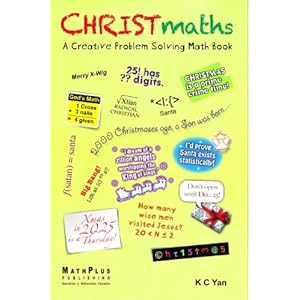
Yan, K. C. (2011). CHRISTmaths: A Creative Problem Solving Math Book. Singapore: MathPlus Publishing.

© Yan Kow Cheong, Dec. 16, 2011.


CHRISTmaths: A Creative Problem Solving Math Book
Now available as an iPad app
http://tinyurl.com/7pn8pau


Thursday, December 15, 2011

25 Things You Wished Were Untrue about Christmas

25. Toys are made affordable for millions of parents thanks to the appalling working conditions endured by under-aged children in Santa’s sweatshops, in China.

image photo : Fractal Christmas trees
Fractal Christmas Trees
© Dreamstime.com
24. Proud CEO: “My time in looking for a five-dollar present for my company Christmas party is worth more than US$2,525—I’d rather issue a check 100 times the amount for the gift.”

23. An e-card costs much less than 25 cents—maybe a mere 2.5 cents plus or minus a few bits and bytes.

22. There are fewer joyful people on Christmas Day than on any other day of the year. Do you know why?

21. Men dishonor Christ more in the 12 days of Christmas than in all the 12 months of the year—by their boozing and carousing.

20. Even staunch Christians may not be aware that Christmas is a pagan feast, originally meant to worship the Sun god, instead of the Son of God.

19. There may be more non-believers celebrating Xmas than believers every year.

© teachercreated.com
18. Singles, poor people, and entrepreneurs could not wait for Christmas to come and go—not a happy time to be alone or be lonely.

17. Many believers and non-believers celebrate Christmas without a genuine understanding of the meaning of the public holiday—probably the most celebrated and the least understood festival of the year.

16. Retailers rely on Xmas significantly on the festive sales to remain financially afloat.

15. People merry so much on Xmas Eve that they don’t have time to open up their Xmas gifts—Boxing Day often becomes a sleeping day!

14. Even believers forget that Christmas needn’t be merry to be meaningful—it is the Christ of Christmas that needs to be celebrated, not Christmas itself.

13. Believers and non-believers are more and more expensively anxious or stressed to buy something to please others—as a sign of showing off their wealth, or exhibiting misplaced generosity.

12. New Christians do not want to be excluded from Christmas as they await for their employers’ Christmas bonus—that universally revered figure.

11. Employees are willing to work under unreasonable bosses because of the Christmas bonus—many at the same place, for the same boss, for more than 25 years.


The Search

© www.sodahead.com
10. Believers from other faiths often feel morally obliged to celebrate Christmas with their Christian colleagues and neighbors, all in the name of religious harmony.


9. Religious fanatics intolerant of Christianity wished Christmas were celebrated every quarter of a century instead of every year.

8. Some people would buy off a Christmas gift for their children on eBay for several thousand times the original price.

7. People max out their credit cards to finance the gift storm, as compared to their grandparents who saved money for Christmas.

6. Some allegedly US-friendly Arab nations tend to treat Christians worse than those living under dictatorial Muslim rule.

5. A month after Christmas, the holiday is only halfway paid off—credit card debt resulting from a borrowed merry Christmas. And a third of the money borrowed for Christmas spending is still not paid off two months after the holiday.

CHRISTmaths: A Creative Problem Solving Math Book
A Christmas gift for numbers lovers
http://tinyurl.com/7pn8pau
4. This Christmas over a billion people in the world are surviving on less than 70 pence a day.

3. Politically correct retailers have banished Jesus and Christmas from the mall to accommodate to the secular demands of agnostics and non-theists.

2. Christmas is celebrated today more like a sales frenzy than as the most important birth in history—the commercial mentality has robbed the message of giving.

1. The closer people get to Christmas, the pressure to give these (useless) unnecessary gifts goes up and they feel depressed and unworthy if they can’t give.

Merry X-W/g to all!


© Yan Kow Cheong, Dec. 15, 2011

Tuesday, July 12, 2011

Mathematical Haikus for Kiasus

Some 17 odd hours ago, I posted "Mathematical Haikus for Goondus* and Suakus" on Facebook. I hypothesized that composing or formulating these 17-syllabled verses may help one to balance the left mathematical part with the often-atrophied right part of the brainHere's another lot of these 5-7-5-like crude non-seasonal poems.


Make Every Nanosecond Count

Three scores and ten
Roughly a billion heartbeats
Use your time wisely

How Many Misteaks Are There?

On the train platform
Train arriving in ''one mins''
That's non-SI time!

Issued by Japan in 1984 


Rightly Theirs
That kids can recall
Pythagorean Theorem
That proves their "math rights"


The Craze Is Back
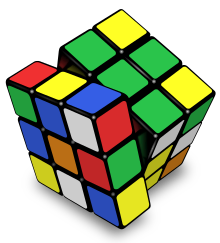
http://www.rubiks.com

Dare to sign up for
Rubik's Cube Competition?
That's raw math talent! 


A Modern-day Rubik Cube

Sudoku, again?
Think of something more worthy
To tickle your brain

http://en.wikipedia.org/wiki/Fifteen_puzzle


Sam Loyd’s Alleged Invention

That cheap toy of yesteryear
Order it on eBay


A Math Competition for All

AMC* is best
The most popular contest
In the world today

*Australian Mathematics Competition


Where Cool Math Things Happen

MAA is cool!
The association to be
For math geeks and nerds


The World's Most Disliked Subject

Why you dislike math?
MATH is a four-letter word
A turn-off for kids

A Key to Unlocking the Universe’s Secrets

Math is a language
With notations and notions
To model the world


Some Like It With an “S”

Is it MATH or MATHS?
It all depends where you live!
Your location counts.


Product Details


The Most Quoted Verse

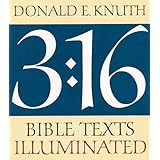
What's John 3:16?
God's numerical message
Of His Love for you


NUMBERS 1:1-36:13 

The Book of Numbers
Is not really a math book
But God's Almanac! 


Social Media MATH

To blog or to tweet?
It's hard to make up my mind
I choose to do both

TWITTER Math

Micromath 4 U
In 140 words
To share your sweet tweets


FACEBOOK Math

Five-minute math posts
On pop culture and gossip
For friends, fiends, and foes


The Chewing Gum Land

A math sanctuary
The ''fine city'' Singapore
Offers jail and cane


Triple Firsts in TIMSS

SINgapore’s success?
A haven of ''cheat/cheap'' books
© Yan Kow Cheong, 2011

To meet kiasus’ needs


Superstitiously Yours 

Friday the 13th 
An urban myth to promote 
Irrational fear


Apocalypse now

Faith in the Mayas
Dec 21, 2012
Where will you be then?


Singapore’s Papyrus

The model method
A mere fad or a cool tool?
To soothe the mind's eye


Faith or Fear in 1’s and 2’s

The Y2K scare
Next it's 12/21/12
Marketing faux fear?


© 2012 Yan Kow Cheong

Another Creative Math Title

Cre8tively yours
Who Took My Calculator?
Coming your way soon!

It's time to compose a few mathematical haikus to tickle the right part of your grey matter. And remember to share them with the rest of the mathematical brethren.

A 17-letter 
m-a-t-h-e-m-a-t-i-c-a-l H-A-I-K-U
Longs to be composed

* Suakus and Goondus are the Asian equivalents of Dummies, Idiots, Blockheads, and Morons.
# Kiasus are those who are afraid to lose out, displaying signs of self-centeredness and selfishness.

© Yan Kow Cheong, July 10, 2011