20. About sixty percent of students know how to differentiate and integrate un-pathological functions by grades 9 and 10—they read two-year "Additional Mathematics" plus four-year "Elementary Mathematics."
19. About ninety percent of students would have had a math tutor by the time they reach grade 6—private tuition is a multi-million-dollar business in Singapore because school teachers know tutors and anxious parents would eventually fill in the gap.
18. Some sixty percent of students complete their secondary education in four years, which includes reading calculus, trigonometry, and proofs in plane geometry.
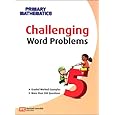 |
| A title that promotes the model method SingaporeMath.com |
 |
| A Singapore wallet-friendly grade 4 title of a six-book series |
16. An estimated 60% of students in every cohort dislike math, because it’s taught in a boringly sterile manner in schools, and often by boring math teachers who are simply teaching math to the test.
15. Statistical anecdotal evidence suggests that as high as 80% grades 1-6 teachers prefer to teach other subjects to math—the painful truth is that grades 5-6 math (with their share of challenging word problems) are harder to teach than grades 7-8 math.
14. Most K-6 math teachers are non-college graduates; interestingly, they’re also known to be better math teachers than their peers armed with a university degree.
A Formula for Singapore's Math Success = 20% Textbook + 30% Teacher + 30% Tuition + 20% Parental Involvement
13. The better math teachers and tutors aren’t teaching in the top schools, but rather in neighborhood ones, with far less-ideal facilities and resources.
 |
| A dear pseudo-monograph about the Singapore model method |
11. The majority of math teachers moonlight, often compromising their day-time jobs—the better ones teach in tuition or enrichment centers, or give private tuition, often charging obscenely.
10. Up to 70% of Singapore students are probably one grade higher than their peers in the United States—for instance, a primary 2 student in a good neighborhood school in Singapore would have covered at least 60% of what a grade 3 student in the US had read, based on the textbooks’ contents from both countries.
10. Up to 70% of Singapore students are probably one grade higher than their peers in the United States—for instance, a primary 2 student in a good neighborhood school in Singapore would have covered at least 60% of what a grade 3 student in the US had read, based on the textbooks’ contents from both countries.
9. Other than those few expensive-cheat math titles written by some lecturers or tuition centers' owners, most Singapore-published math textbooks and assessments are value-for-money titles vis-à-vis the expensive, thick, colorful—inch-deep, mile-wide—textbooks published in the US.
8. The power and beauty of the Singapore model (or bar) method is mostly appreciated by those outside Singapore, as compared to an unappreciative lot of local math teachers. Since the late eighties, they've been inundated with an unhealthy number of assessment (supplementary) books, aimed at promoting the visual heuristic—today, most local math teachers treat the model method as a hype or a bore.
7. Most elementary math teachers and graduates-parents have difficulty drawing a model when faced with a grade 5 0r 6 challenging word problem, preferring to use algebra instead to solve them—without peeking at the model-or bar-method solutions, most parents are unable to help their grades 5-6 children with their school homework.
6. Most math teachers feel uncomfortable or ill-prepared to coach their own students for math contests and competitions, leaving the task to trainers from private companies, or to coaches from mainland China.
5. Local mathletes are trained to answer questions that would defeat most secondary teachers, who are primarily drill-and-kill specialists employed to produce exam-smart students to outperform their peers from other Commonwealth countries.
4. Singapore-published textbooks and assessments are mostly written or ghostwritten by foreign-born authors, most of whom have never taught in primary or secondary schools, or by lecturers supervising trainee-teachers.
 |
| A decade-old Singapore bestseller http://tinyurl.com/3cctqcg http://tinyurl.com/3uy5hou |
4. Singapore-published textbooks and assessments are mostly written or ghostwritten by foreign-born authors, most of whom have never taught in primary or secondary schools, or by lecturers supervising trainee-teachers.
3. Most Singapore-published math titles are "edited" by non-Singapore citizens, who only have a smattering understanding of the local educational system.
2. An unhealthy number of school textbooks are rewritten or ghostwritten by editors for their PhD authors—many titles-conscious general editors or consultants are notoriously known to contribute quasi-zero input and to collect an undeserved royalty or lump sum payment.
1. Singapore is a haven for assessment math titles, but a hell-on-earth for mathophobics who are forced and terrorized by parents and tutors to go through hundreds of non-routine or challenging word problems, so that they'd remain ahead of the competition. The only consolation is Singapore's top ranking in TIMSS; more medals at contests and competitions, and more university places at top universities.
Indeed, Singapore firsts in math education comes with a high price and with much pain and suffering for students, teachers, tutors, parents, writers, editors, and publishers. Not to say, tens of thousands of students who feel shortchanged and alienated by the culture of mathematics challenge, resulting in poor self-esteem and a dislike for the subject!
© Yan Kow Cheong, November 2, 2011.

