Welcome to K C Yan's Singapore Math blog!

Wanting to be updated on Singapore Math news or new Singapore Math? You have come at the right place! Please leave your comments before leaving. A googol thanks.

Singapore Math

Friday, November 19, 2010

52 Ways to Become a Zero Hero

Not too long ago, even the Catholic Church banned the use of zero, blaming it as some Godless number. Today, in some religious or philosophical quarters, zero is still associated with some abyss, hell, or nothingness. And in mathematical circles, it took a while for mathematicians and scientists to treat zero just like the other nine numerals – indeed, zero was the last one to gain its rightful citizenship in the number system.

Despite zero’s early struggle to be recognized before it was eventually immortalized, how could we, mathophiles and mathophobes, play our part in promoting the idea that zero is not nothing, but something?

Here are some yearlong activities you may promote and pursue to elevate Zero to a Hero. Who knows? You may turn out to be a zero celebrity!

52. Buy a lottery with the four digits 0000, thus increasing your chances of probably being the sole winner.

51. Solve some math problems with zero clothes (in the privacy of your home), and get to share your aha! moments with your mature students.

50. Be part of a “Zero Tolerance Week” – no complaining or swearing for 24/7.

49. Solve the zeros (or roots) of some quartics (polynomials of degree 4) at a fast-food outlet, or while you are lining up in a supermarket.

48. Write some graffiti about zero, which would likely be a talking-point among geeky pedestrians during lunchtime or at pubs.

47. Call a dozen people with a phone number containing five or more zeros, and unearth any possible correlation between choice of digits and superstition.

46. Work out how many seconds you have left to live in standard form, and make every second count, before your last heartbeat.

A DIY Shirt
45. Wear a T-shirt with the words, “Zero is my hero!” and jot down the facial expressions of onlookers.

44. Tweet or blog about a stereotype on zero: “The rich are dispensers of zeros!”

43. Depict the imagery of some imaginary zero god, drawing people to “zero worship” instead of “hero worship.”

42. Write a novelette entitled, “The Naked Zero” or “A Tale of Zeros.”

41. E-mail a proverb or aphorism about zero to 100 friends, such as “Nothing ventured nothing gained,” and summarize their common responses in a pie.

40. Review 10 books on or about zero, and compile them into an e-book, entitled The Savage Truth About Zero, to be downloaded free of charge.

39. Write an anti-virus program that afflicts PC users with dates ending with a zero.

38. Count down to everything, NASA-style – from praying to playing to paying.

37. Call anyone you meet in the street a zero – a Zero Ridicule Day.

36. Create an optical illusion or random-dot stereogram about the number zero.

35. Imagine a world sans zero and write about its potential benefits.

34. Be a zero-schizophrenic, by zeroing on anything with nil, nought, and naught.

33. Be an advocate of the Zero Defect Movement – zero accidents, zero casualties, and so on.

32. Sponsor obituaries of strangers with zero heartbeats, who left zero savings for the family.

31. Give or ghostwrite eulogies of people with zero heartbeats, who used to issue or give away checks with no fewer than five zeros.

30. Send a month of problems to the Mathematics Teacher with all answers zero.

29. Give away a million seconds of your time to charity every year (about 34 days of 8 hours) at zero costs.

28. Google “zero,” and compile a list of most-visited sites, which reveal some odd behaviors of the numerical troublemaker.

27. Borrow some books on “Nothing” or “Nothingness” and annotate them to lure readers to borrow one of them.

26. Write a features article on a football match that ended in a 0-0 bore-draw.

25. Imagine what would happen if there were a zero year: 1 BC, 0, 1 AD.

24. Meditate on nothingness, then compose some Zen-like inspiration messages.

23. Publish a book with all blank pages – a revised edition of The Nothing Book for the third decade of the new millennium, or create a cottage industry with zero-texts titles such as “What Men Know About Women,” What Men Know about Aliens,” and the like. 

22. Popularize a series of Christmas lectures, christened Zero-Lite, to an often-innumerate or mathophobic public.

21. Compose jaws-dropping limericks and haikus about the number zero.

20. Write and mail checks of zero dollars to 100 friends, then expect the unexpected from them.

Shot taken from a train's ad
19 Organize a Zero Festival to humanize the beauty and power of zero. 

18. Run a campaign to educate the public about corporations and retails outlets, which are out to lure the public into falling into the "zero syndrome” trap: zero interests, zero down payment, zero fats, ....

17. Plan a Math Carnival with Zero as the theme for the month.

16. Explain to an eight-year-old why a point has zero dimensions.

15. Persuade decision makers in your faculty to add a few zeros to the budget for “zero” research, such as on the Zero Option, to commemorate or recognize the contribution of zero to humankind.

14. Recount the aftermath (pain, casualties, atrocities) of the Cambodian people when Kherme Rouge changed the calendar back to Year Zero, as part of a Multicultural Math elective in a college quantitative literacy course.

13. Preach on the costly or deadly consequences of disobeying the eleventh commandment: Thou shalt not divide by zero!

12. Come up with ten creative ways to help a mathematically challenged public for often mistakenly taking the letter “O” for the numeral “0.”

11. Set up a Facebook page for fans of the “Zero Fiends.”

10. Advocate a zero-tolerance policy for drugs and debts among disadvantaged kids and hardcore gamblers in poor neighborhoods.

9. Conduct public talks to the young that they and their offspring wouldn’t be paranoid of millennium years: 2000, 3000, ….

8. Promote the idea of zero pets at food courts and shopping malls as a sign of good hygiene.

7. Be a Carbon Hero, by embracing a “carbon zero” lifestyle, by using public transport and ordering e-books.

6. List down no fewer than ten sociological or psychoanalytical uses of zero.

5. Set a 2020 goal of achieving near-zero innumeracy as an educational goal among elementary school students.

4. Start a Zero Digest zeroing on the mathematical, philosophical, and spiritual zero, and place advertisements as a way to reduce the price to $0.00.

3. Come up with a number of rebuses related to the number zero or expressions about zero.

2. Campaign for a zero-situational-ethics working environment.

1. Follow K C Yan on Twitter as @Zero_Math and share your “zero” tweets with the zero-math brethren.

© Yan Kow Cheong, November 17, 2010

Saturday, September 25, 2010

The Lighter Side of Singapore Math (Part 2)

In Praise of Models

A K-8 Sample of Singapore Math Questions

Grade 1
Use the [Singapore] model method to show that (a) 2 + 3 = 5, (b) 9 – 4 = 5. 

Grade 2
Use a model to show that 3 × 6 = 6 × 3. 


Grade 3 

Use a model to show that ½ × ⅘ = ⅖.

Grade 4
Use a model to show that 2 ÷ ⅖ = 5. 

Grade 5
Use the model method to evaluate the value of 3½ × 4⅚. 

Grade 6
Use a model diagram to show that the infinite series converges to a finite number.

½ + ¼ + ⅛ + ⅟₁₆ + ... = 1 

Grade 7
Use a model to show that (2x)² is not equal to 2x². 

Grade 8
Use a model method to solve these equations.
(a) x² – 3x                  (b) x² + 3x + 5 = 0

Singapore World Records 

Most participants in a ribbon-cutting ceremony (3,238)

People wearing balloon hats at one time (1,491) 


Most people caught jumping queues at one time (?)

The first (or fastest) one to board a train at a newly open train station (? sec)

 
Most number of people solving a word problem using the model method (n!?)

The world's gigantic math model cut on grass (?)

Wittgenstein’s Ghost 


Math educator
: Let one unit represent the number of Singapore Math books.
Homeschooler: But, Dad, suppose one unit doesn’t represent the number of Singapore Math books.  

New math titles in the pipeline

1. The Singapore Model Method for Those with Zero Sight 
[By a Singapore-born blind math educator]

2. A Bluffer’s Guide to the Singapore Model Method
[Pending approval from the Censorship Board of Adult Education]

3. Singapore Math for SENIORS
[A CHRISTmaths gift for grandparents & godparents]

4. China Math vs. Singapore Math: Which is Better?
[Does this include Taiwan Math?]

5. Singaporeanizing Math 
[What on earth is that?]

An Evolution of Grade 5/6 Singapore Math Word Problems

Teaching Math in 1970 (Traditional Math)
Mr. Yan has three cows and eight chickens. How many legs are there altogether? [Ask a next-door neighbor for the answer.]

Teaching Math in 1980 (Model Method)
Mr. Yan has twice as many cows as chickens. If there are 64 legs in all, how many cows are there? [Ask a neighborhood school teacher for the answer.]

Teaching Math in 2000 (Problem Solving)
Mr. Yan has cows and chickens. If there are altogether 28 legs, how many chickens and how many cows are there? [Ask a full-time tutor for the answer.]

Teaching Math in 2010 (Challenging)
Mr. Yan has almost twice as many chickens as cows. The total number of legs and heads is 184. How many cows are there? [Answer a math coach, or a volunteer from the Ask Dr. Math Website.]

The Core of the Singapore Math Student

What the most-disliked subject means for the average or above-average Singapore student (in spite of TIMSS):

K1-K2: Math is a lore.
Grades 1-2: Math is a score.
Grades 3-4: Math is a bore.
Grades 5-6: Math is a chore.
Grades 7-10: Math is a sore.
Grades 11-12: Math is no more. 


© Yan Kow Cheong, September 25, 2010

Friday, September 3, 2010

Nine Daffynitions of 999

Anyone of you ever thought of dialing 999 for help in solving some of your elementary math problems? Well, you never know! There might be some bored police personnel on night duty longing for a change in handling the usually boring calls related to ambulance, fire, and robbery.

In fact, in the name of productivity it's not a far-fetched idea to recruit policemen and women who can also render numerical assistance to their mathematically challenged callers, especially in the middle of the night when there're fewer emergency calls, and when these bored (or boring?) staff tend to doze off often.

Traditionally, a number of developed and developing countries have inherited a mathematically challenged police force. May each country or county be blessed with better-educated police personnel who are confident to handle complex real-life problems, whose solutions often requiring an above-average logical and rational mind.


Here are nine extra-definitional meanings of 999.

9. Police on fire calling for ambulance
8. Police firing at stolen ambulance
7. Police chasing ambulance on fire
6. Ambulance ferrying police on fire
5. Ambulance on fire injuring police
4. Ambulance and police both on fire
3. Police in stolen ambulance on fire
2. Police looking for fired ambulance
1. Fired police in ambulance on fire

What's your definition (or daffynition) of 999? Share yours with the rest of us.

Nitely yours


© Yan Kow Cheong, September 2, 2010

Friday, August 27, 2010

The Abacus as a Divination Tool

For generations of Chinese traders and shopkeepers, the abacus (called suanpan) has been an indispensable tool for calculation and for finding the financial health of their business – the profit and loss of their trade.

Two Chinese and two Japanese abaci 
Less well known is that the suanpan is also used as a divination tool among many Chinese migrants. If you go to Chinatown today, you can still see old folks (who are usually the owners of their businesses) strike the beads of their abacuses before opening their shops in the morning. Striking the abacus is perceived to be a good omen: This primitive calculator will be used often throughout the day, indicating brisk business. And the louder they strike the beads, the better the business. 

The choice of the beads (sizes, shapes and types) matters. The common beads are made of wood, stone, silver or gold, each serving a different purpose. For example, some beads are chosen as they allegedly help to secure a faster job promotion, while others to gain health and wealth. 

Moreover, the placement of the abacuses (or abaci) at home or in the office is important to ensure that there is no bad feng shui (meaning “wind and water” in Chinese). Furthermore, the positioning of the abacus also changes with each Chinese zodiac year – twelve animals which repeat themselves every twelve years.

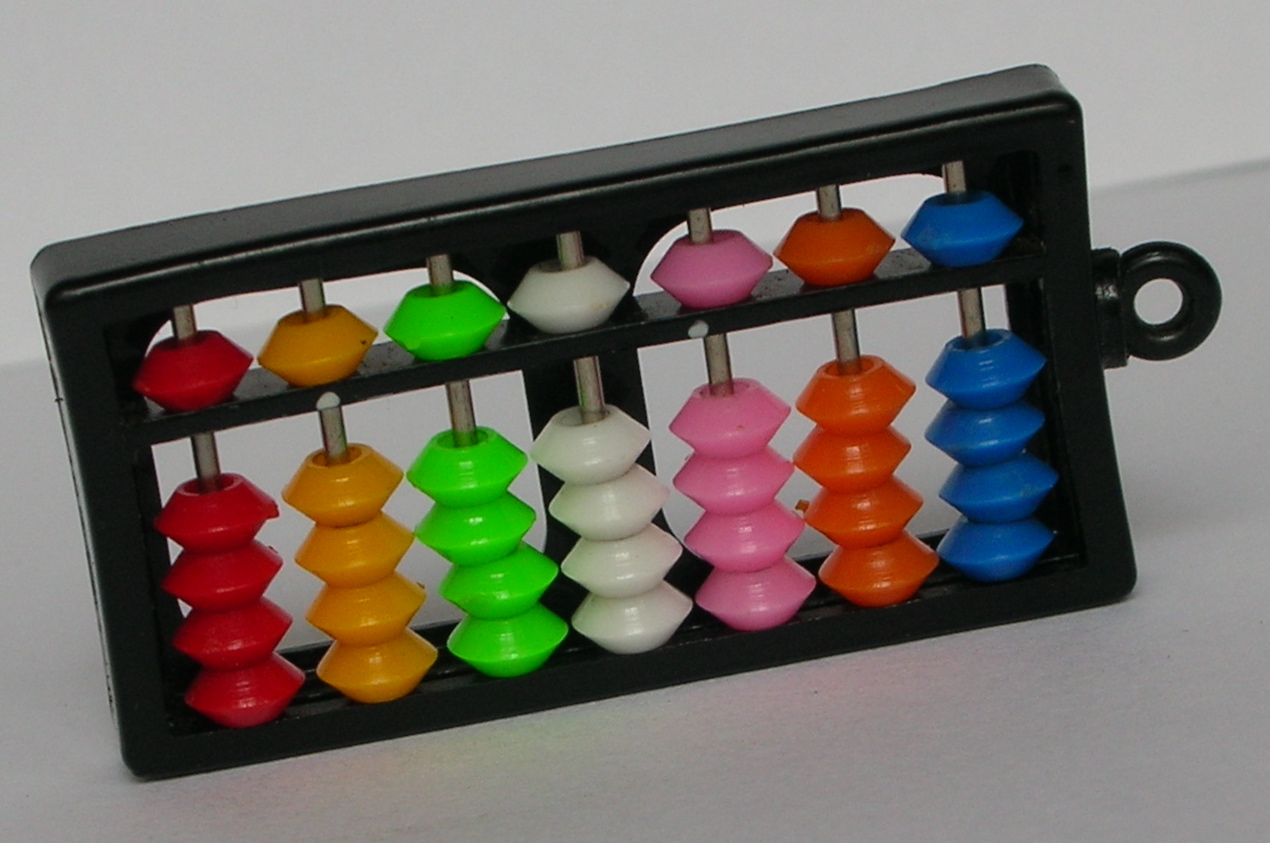
A 4 cm by 2 cm Soroban
Some years ago, I bought a small key chain that comes with a tiny golden-looking soroban (Japanese abacus). It never occurred to me then that this little ornament could serve as a divination tool for good luck. Today, it is not uncommon to see souvenir shops selling abacus-pendants (silver or gold bracelets, earrings, and the like) – some kind of amulets to thwart off any evil spirit, or some divination tool to attract success and prosperity.

So, the next time a friend gives you an ornament that comes with a cute-looking abacus as a gift, think twice before wearing it. You may unknowingly be the recipient of some superstitious or irrational belief that good luck is yours to come; or worst, if it's from some fiend or foe, you could be under the curse of some object of worship.

For reflection 

0. How would you reason with (or respond to) someone who faithfully believes that abacus-pendants are to be worn for good omen?

1. Give five reasons why people use the abacus as a symbol of prosperity and wealth.

2. What are some dangers in using the abacus as a divination tool?

3. How can you educate the public that wearing abacus-pendants as a sign of good omen will only promote pseudoscience and innumeracy?


For Mathepreneurs ONLY

1. Design an abaculator.
2. Improvise a solar-powered soroban.
3. Invent an electrified suanpan.

© Yan Kow Cheong, 26 August, 2010

Thursday, August 12, 2010

Aptitude Test for Math Editors

Senior and managing editors in local publishing houses have always lamented how hard it is to recruit decent mathematics editors, because CV’s and interviews often fail to filter the good from the mediocre candidates. On the other hand, few senior editorial staff dare to look in the mirror to see whether they themselves have what it takes to mentor or guide their editors. There is a Chinese or Japanese saying that says: "An editor shames her managing editor." The less-than-desired-quality of a published math book often reveals much about the competency of those behind its production.
 
Many years ago, I suggested administering a quantitative test to shortlist potential math editors interested in making publishing a career, in the hope that this may help reduce the relatively high attrition or casualty rate in the industry.

Below is a sample of questions we may pose to applicants keen on becoming word doctors in charge of mathematics titles, up to pre-university level.

A Test to Identify Math Editors

1. A writer approached two publishing houses for a manuscript she recently completed. The royalty rates are as follows: 


                       Publisher             Royalty rate

                                          A                    10% published price
                                          B                     12% net price
  
Net price is the price after 40% discounts to the bookstore.

(a) Which publisher should she choose?
(b) Another writer wants to know what percentage of the net price from Publisher B would yield a royalty equal to the published price from Publisher A. What percentage will this be?

2. Two publishing houses have the following mode of payments:


                 Publisher             Mode of payment

                              X                  $5000 + 5% royalty on published price
                              Y                  8% published price

Which publisher gives a better deal?

3. Due to the many errors in a geometry book, a printer had to replace pages 28, 29, 109, 130, and 131. How many sheets of paper did the editor have to reprint? 

4. Mathematics Digest, which has a special 16-page feature in the middle, is incomplete. The third page of the supplement (page 15 of the newspaper) is missing. What other pages must also be missing?

5. Four pages of one section of a newspaper are missing. One of the missing pages is 13. The back page of this section is 40. What are the other three missing pages?

6. When asked by her editor to add the page numbers of the section on Random Numbers he wrote, Mr. Goon said it was either 216 or 256. Which was it?
  
7. Ricky tore out several successive pages from an algebra book. The number of the first page he tore was 143, and the number of the last page is written with the same digits in some order. How many pages did Ricky tear out of the book?
  
8. The middle sheet is removed from a manuscript, handwritten on both sides of the paper. If the two sides are numbered 6 and 7, how long is the script?
  
9. Pages 6 and 19 are on the same double sheet of paper. How many pages does the newspaper contain?

10. A 60-page newspaper, which consists of only one section, has the sheet with page 7 missing. What other pages are missing?

Time limit: One hour 45 minutes for foreign applicants, or two hours for Singapore citizens and permanent residents.* 

If 75 percent were the passing mark for the above quiz, what would be the probability that half of the applicants who took the test would be shortlisted? How many could be considered a true-blue math editor or senior editor?

Two Standard Deviations from the Norm

In recent years, one recurring complaint among seasoned and prospective writers in academia and in schools, keen to write fertile math titles, is that we lack the local expertise or know-how in publishing quality or decent math titles other than locally approved school textbooks and workbooks. In fact, current editorial standards seem to be one or two deviations from the mean, as compared to what they used to be in the nineties.

The future of publishing decent math titles other than school textbooks looks uncertain, to say the least, as fewer ex-teachers are joining the publishing industry due to better job opportunities in other industries, where pay and promotion are much more attractive. Besides, there are few role models for novice editors to emulate should they choose to make publishing a career. Few math majors, if any, are in charge of math titles these days, and the editorial standards in a number of local small publishing houses (which churn out assessment titles like they're selling iPhones) leave much to be desired. 

Self-publishing on the Rise

Across the industry, editors' weak mastery of math concepts and poor linguistic skills would only aggravate an already-declining editorial quality of math titles. Most proofread instead of edit, or simply take care of the grammar instead of rewrite. In recent years, it isn’t surprising to witness many writers and authors switching to self- or vanity publishing, because few writers and teachers believe that there will be added value to their manuscripts, other than cosmetic improvements, going by the influx of assessment or supplementary titles inundating the local market every year.


A Third-class Industry in a First-class Economy
  
A common-sensical step in addressing the often-decried “Singapore-has-a-third-class-publishing-industry-in-a-first-class-economy” issue for its educational titles is to bring in better editors on board the editorial ship, or to recruit foreign talents who have worked no fewer than three years in established foreign publishing houses. Because little attention is given to the pay and remuneration, and to the opportunity to upgrade oneself professionally, the dearth of decent [math and science] editors isn't likely to reverse any time soon. A lack of passion and professionalism seems to be the currency of many editors these days. 

Singapore, a Publisher of Choice

As Singapore aspires to become a key player in math education publishing, local houses can’t afford to have math editors with an average knowledge of the subject matter and a below-average command of the English language. Having math editors with a mastery of the subject matter and a working fluency of linguistics isn’t an option if the country wants its math titles to graduate from a third- or second-class quality to match its first-class economy. And producing quality math titles other than school textbooks is the first sign or step to position Singapore in becoming an Asian publisher of choice in producing first-class math and math education titles.

* This apparent inequality is in line with the recent government's policy that Singaporeans come first, especially when it comes to providing jobs for locals and foreign residents.

 © Yan Kow Cheong, August 11, 2010.